10.08.26 - 20:00
Purpose – The purpose of this paper is to document how Paul Otlet, founding-father of what is termed at present as “information science”, attempted to provide a complete “image of the world” (and reality in general) by establishing the scientific discipline he dubbed “documentation”. The paper also aims to focus on how Otlet represented human knowledge and reality in a systematic and unified way.
classification systems, files and
L'univers, l'intelligence, la science, le livre - Paul Otlet,Traité de documentation (1934)

L.B. Direct alphabetic index (1921)

Applied secretarial practice
by John Robert Gregg (1941)


* * * * * * * * * * * * * * * * * * * * * * * * * * * * * * * * * * * * * *
09.08.26 - 09:00
The opposition between objective and subjective links proposed by Paul Kahn pertains most to legacy documents, such as works originally intended for print, including scientific papers and scholarly articles, dictionaries, and encylopedias -- all of which contain explicit reference structures, such as foot- and endnotes, glossaries, and "see also" or "viz." commands. All of these directions convert to hypertext links, and the conversion can be automated.
arrows and arrows and arrows
[vizualising linking]
Forms of Linking, Their Uses and Limitations
Objective vs. subjective links
Subjective or associative links, in contrast, are added to the text by hypertextualizers or hypertext authors, but they often depend on the existence of newly available material and can rarely be based on document structure. They demand domain knowledge. A content expert or author (as opposed to a programmer) has to create them.
Document to document
 Lexia to Lexia Unidirectional Linking
Advantage 1 (1) Simple — requires no planning.
Disdvantage 1 Produces very brief lexias and hence choppy text.
Disdvantage 2 Disorients when used with long document because readers do not know where links lead.
String to document
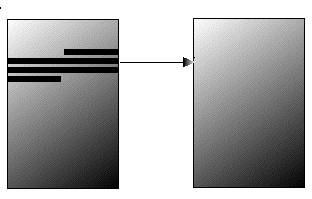 String (Word or Phrase) to Lexia Linking
Advantage 1 Provides simple means of orienting readers.
Advantage 2 Permits longer lexias (documents).
Advantage 3 Encourages different kinds of annotation and linking.
Disadvantage Disorients when used with long destination documents, since readers do not know to which part of it the link leads.
Comments This is the characteristic form of HTML linking when the link does not include a specific anchor.
Many-to-one links
 Many-to-one Linking
Advantage 1 Very handy for glossary functions or for texts that make multiple references to a single text, table, image or other data.
Advantage 2 Encourages efficient reuse of important information.
Advantage 3 Provides simple means of producing documents for readers with different levels of knowledge or expertise.
Disadvantage Systems that create many-to-one links automatically can produce a distracting number of identical links.
Comments This form of linking is one of the great strengths of HTML.
One-to-many links
 One-to-Many Linking
Advantage 1 (1) It encourages branching and consequent reader choice.
Advantage 2 (2) It permits efficient author-generated overview, directory, or sitemap documents.
Advantage 3 When combined with systems that automatic provide link menus and other preview functions, it helps greatly in orienting readers.
Disdvantage (1) It can produce a sense of an atomized text.
Comments (1) The lack of such linking is a fundamental weakness of HTML and the WWW.
Typed links
 Typed links
Advantage 1 If clearly labeled, a typed link acts as a form of link preview that provides readers with reassurance and necessary information.
Advantage 2 It can produce different kinds of link behavior, including pop-up windows.
Disadvantage Can clutter reading area or confuse by producing too many different actions when one follows links.
Comment 1 Intermedia first used two different link types — comment an annotation — but found that one person's comment was another's annotation.
Comment 2 Some hypertext systems make typed links their central feature.
Visible vs. Invisible
 Advantages
1. The text is not cluttered with underlining, blue (or other special) colors to show the presence of links.
2. Links in or links out — arrival or departure links — are easily located.
Comments
1. As in Intermedia and Storyspace, Microcosm (shown above) the show links feature is activated by a menu item or a key combination.
2. Storyspace and Microcosm show the presence of links with white text on black background; Intermedia used a blinking marquee.
3. The absence of such a feature in HTML is disorienting when readers enter a long document: they may know where to begin reading but not where to end.
who knew they were so many different links types?
Ted Nelson Computer Lib/Dream Machines, 1974, by Amber Case is licensed under CC BY 2.0 via War on Terrorism-Data: A Research Note by Olof Sundin

* * * * * * * * * * * * * * * * * * * * * * * * * * * * * * * * * * * * * *
08.08.26 - 22:30
The concept of the memex was highly influential, eventually leading to the invention of the World Wide Web and its Hypertext Markup Language (HTML).
For this reason, some people assume that the web is an advanced version of memex. But in fact, the web is a terrible approximation of Vannevar Bush’s original vision.
Vannevar Bush, who is generally credited with the idea of hypertext (though not the term itself) developed his idea of a Memex, or memory extender, sometime in the 1930s and published it in his seminal 1945 article, "As We May Think." Nelson and many subsequent writers on hypertext see it chiefly as atomized text, which includes images and other forms of data, joined by links. Bush, in contrast, emphasizes paths and trails of links as a new form of writing imposed upon existing print-based texts.
Arguably the Internet forms one big memex today. Bush was right in his prediction that "wholly new forms of encyclopedias will appear". [...]
But Bush imagined the memex as a private (though shareable) record, not a communal one. Each person should have their own memex.
The device’s name came from combining portions of (mem)ory and (ex)tender. It began with Vannevar Bush feeling overwhelmed by the influx of details he had to deal with, let alone intelligence he’d never be able to access. He complained about information transmission methods being outdated and inadequate for professional purposes. Since new material would simply draw in a data ocean, every new scientific research would provide ever-diminishing returns. We’ve discussed this topic on an early issue.
L’invention par Vannevar Bush d’une mémoire mécanique partagée entre la machine et d’autres utilisateurs s’inscrit dans le contexte trouble de la bombe atomique. Si les hommes ne parviennent pas à résoudre leur conflits autrement que par la guerre, la bombe aura raison de l’humanité. Le contexte historique dans lequel s’invente l’informatique est pris dans une ambivalence entre le calcul scientifique et la bombe atomique, entre la rédemption et la destruction. L’arme nucléaire serait le moyen le plus efficace pour générer un événement d’une violence inouïe, tandis que l’ordinateur (encore non nommé et non réalisé) pourrait être vu comme ce qui ramènerait de l’ordre au sein d’un monde divisé ; l’informatique serait ainsi le double inversé du nucléaire.
it's time to talk about the Memex again
[A memex (a portmanteau of "memory" and "index") is a hypothetical electromechanical device for interacting with microform documents and described in Vannevar Bush's 1945 article "As We May Think". Bush envisioned the memex as a device in which individuals would compress and store all of their books, records, and communications. The individual was supposed to use the memex as an automatic personal filing system, making the memex "an enlarged intimate supplement to his memory". wiki/Memex]
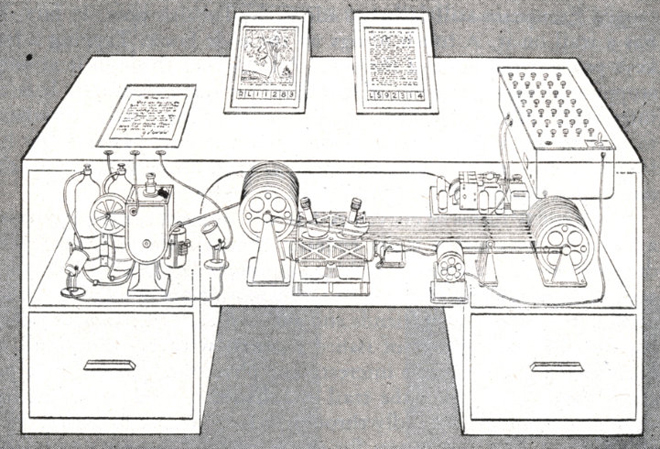 The concept of the memex influenced the development of early hypertext systems and personal knowledge base software.[2] The hypothetical implementation depicted by Bush for the purpose of concrete illustration was based upon a document bookmark list of static microfilm pages and lacked a true hypertext system, where parts of pages would have internal structure beyond the common textual format.
Memex is already here, it’s just not evenly distributed
by Filip Hráček
[on the ways we can use existing software and technology to create our own Memex]
His “trails” are similar in concept to a physical binder that contains documents that you can freely annotate, highlight and interlink. Any given document can of course be in multiple different binders, and its annotations and links depend on the context. Even for a single person, every “page” can exist in several different forms, depending on what the person is researching or trying to remember at the moment.
Vannevar Bush's Memex
by Hypertext and hypermedia
[A proposition of hypertext definition]
Drawing upon both Bush and Nelson, therefore, I propose the following definition Hypertext, a term that includes hypermedia, signifies text composed of blocks of words (or images) linked electronically by multiple paths, chains, or trails in an open-ended web (or electronic book). Hypertext, in other words, is an information technology in which a new element -- the link -- plays a major part. All the chief practical, cultural, and educational characteristics of this medium derive from the fact that linking creates new kinds of connectivity and reader choice. Hypertext is therefore properly described as multisequential or multilinear rather than nonlinear writing.
How to Make a Memex
by Sarah Constantin
[On the difference between a private memex and a personal one]
Memex: A Romantic Theoretical Tool for Thought, If my grandmother was into PKM, she would have had a Memex.
by Malik Alimoekhamedov
[The elements composing the memex]
Since its original proposal in 1945, the design underwent two revisions: one in 1959 and the other in 1967. Those revisions were the result of technological advancements of those respective periods. However, the main idea and the goal Bush tried to achieve remained unchanged.
Besides the wooden desk acting as the all-encompassing enclosure, there would be several core parts:
Two slanted touch screens would enable one of the fundamental innovations: the ability to see the origin of the information and the trails it leads to. So, not only would you be able to view a document, but you’d also be able to traverse their interconnected network. The user could operate those screens with a stylus!
A built-in camera could be used to ingest a picture into Memex for future retrieval.
A mechanised microfilm ribbon for storing images taken with the abovementioned camera.
A keyboard for punching in numbers to classify and retrieve information based on document IDs.
A joystick for navigating between related documents.
A voice recorder.
La pensée associative du « memex »
by Anthony Masure
[On the context of conception of the Memex]
La science, en améliorant l’accès à l’information, pourrait faire grandir la connaissance et la sagesse afin d’éviter les conflits humains. Pour atteindre cet objectif, l’article articule la conception d’un cerveau compris comme processus calculatoire et les prémisses d’une « pensée associative », qui serait d’un autre type que du simple traitement de données. Le cœur du texte décrit un mécanisme permettant d’archiver et de classer des mémoires savantes. Il s’agit concrètement de mettre en place un dispositif individuel par opposition aux dimensions énormes des calculateurs de l’époque :
Imaginons un appareil de l’avenir à usage individuel, une sorte de classeur et de bibliothèque personnels et mécaniques. Il lui faut un nom et créons-en un au hasard, « memex » fera l’affaire. Un memex, c’est un appareil dans lequel une personne stocke tous ses livres, ses archives et sa correspondance, et qui est automatisé de façon à permettre la consultation à une vitesse énorme et avec une grande souplesse. Il s’agit d’un supplément agrandi et intime de sa mémoire.
Vannevar Bush dépasse le simple stockage de souvenirs et d’informations pour penser un nouveau mode de pensée. La mémoire humaine est plus qu’un objet formé d’autres objets. C’est, dit Vannevar Bush, un « réseau de pistes » fonctionnant par associations, recoupements et regroupements. Quand l’esprit humain est sollicité par un objet, il l’associe instantanément (« snap ») à d’autres qui lui sont suggérés par ses capacités mentales :
C’est exactement comme si on avait rassemblé les documents réels pour faire un nouveau livre, en mieux car chaque article est relié à une multitude de pistes. […] Des formes entièrement nouvelles d’encyclopédies vont apparaître, prêtes à l’emploi avec un réseau de pistes fonctionnant par association, prêtes à être insérées et amplifiées dans le memex
* * * * * * * * * * * * * * * * * * * * * * * * * * * * * * * * * * * * * *
07.08.26 - 9:30
Of Glory not a Beam is left
Go thy great way!
Asterisks often act as footnotes, a tool considered by writer and curator Legacy Russell in her 2021 AICA-USA Distinguished Critic Lecture at The New School, presented in partnership with the Vera List Center for Art and Politics. Through a Black queer feminist lens, Russell centers the margins, counter-text, and counter-narrative, asking “What happens when the footnotes become the text?”
As I contemplate these texts and histories related to the symbol, I return to Dickinson and her declarations.
to continue on the subject of Dickinson, i would like to explore here her relation to asterisks and signes de signes-de-renvois
first it seems obvious to read what she wrote about asterisks :
The Asterisk is for the Dead
But her Eternal House -
The Asterisk is for the Dead,
The Living, for the Stars -
Of Glory not a Beam is left (1685)
For what are Stars but Asterisks
The Stars thou meetst
Are even as Thyself—
For what are Stars but Asterisks
To point a human Life?
Go thy great way!
(1638)
i discovered the poems in the article : on asterisks (*for the stars) by danilo machado
[This essay is part of the Fall 2022 edition of Post/doc: * as in Correction*, reflecting on the symbolic potential of the asterisk (as in Correction*) as a tool to amend, to hold space, to contradict, or to expand.]
In the context of deep cultural and political shifts, Russell ponders how we can use the footnote as “a protective locality to quite literally hide in plain sight” and create “encrypted portals for thought, language, community, being, becoming.”
She considers the footnote’s potential as “an armor and shield, as a place to curl up and rest so we don’t curl up, exhaust ourselves, and die.” She names it “a love space;” a “weird space to do weird work collectively,” a “congregation”—asserting that “all of us as footnotes are a threat.”
What of the stars? Of the visual overlap between the asterisk’s radiating stems and the glow of far-away plasma held by gravity? Do the outward gestures made by these little stars represent a distancing between symbol and significance, between language and meaning? Does its impact equal the scale of stars themselves, or is it as small as astral bodies seem looking up from the ground?
What of the asterisks we leave for the dead? Do their citations just conjure passed writers, or point at words so unalive they need a caveat? Do they live in the “subterranean,” the place where, as Russell remarks, tombstones and footnotes are held? Is the asterisk’s compliance in acts of censorship, silence, and erasure a kind of death, too?
What about asterisks for the living—be they tools to mend human mistakes from misplaced fingers making typos, or annotations to communicate stage direction or emphasis? What of the neural sparks that allow us to fill in a dirty word from a single letter? What is more alive than a confession of error or incompleteness? What signs of life persist within a pause, or a breath between psalms? To quote another Dickinson poem, “For what are Stars but Asterisks / To point a human Life?”
* * * * * * * * * * * * * * * * * * * * * * * * * * * * * * * * * * * * * *
06.08.26 - 17:30
Block reference mechanisms, Slouching toward Xanadu
by Gordon Brander
[How to construct, deconstruct, and reconstruct thoughts into new thoughts? This was the original motivation behind hypertext, and there are a handful of software mechanisms that can help us do better than blue links.]
In an important sense there are no "subjects" at all; there is only all knowledge, since the cross-connections among the myriad topics of this world simply cannot be divided up neatly.
Ted Nelson, 1974, “Computer Lib/Dream Machines”
Break docs down into smaller thought legos
Perhaps the most direct way to make thought legos is to break big documents down into smaller, reusable blocks.
Most written documents are made up of something like a series of smaller “idea chunks”, usually paragraphs.
What might this look like? Well, if you’re saving data to files, instead of saving a document to a file, you might save every block (paragraph) into it’s own separate file.
Purple numbers place IDs in prose
Purple numbers are unique IDs that are automatically generated and placed within paragraphs, making them uniquely addressable.
Why Purple Numbers? The concept was popularized by a piece of wiki software back in 2001, called “Purple”.
Purple Numbers are a clever hack because you can work them into many existing kinds of systems. You just stick a few ID tags in useful places. It’s like dog-earing the page of a book to find your way back.
Offset links reference ranges in documents
What if you want to reference part of a work that spans less than a block, or spans just parts of two or more blocks? Ted Nelson’s Project Xanadu uses a clever technique I’ll call offset linking to carve out exactly the pieces of a document that you want to reference. At the heart of Xanadu is a file called an EDL, or Edit Decision List. An EDL is a list of links, together with a range. The range describes a start position, offset from the beginning of the document, plus a length.
Text fragments select excerpts by search
But there’s another way to mitigate the brittleness of offsets. The Web Platform Incubator Community Group recently introduced Text Fragment links.
Like the Offset Links in EDLs, Text Fragment links are a kind of standoff markup. You and I can reference the same document, but point to different parts. Unlike Purple Numbers, text fragment links don’t require the cooperation of the document being pointed to.
But the real brilliance of text fragments is that they’re resilient to change. Offset links are sensitive to global change. With an offset link, a change anywhere in the document above the offset will break the link. By contrast, text fragment links are only sensitive to local change. A text fragment link will only break if the specific text fragment being referenced disappears from the document.
Even better, text fragments work with the web we already have.
I didn't know it was possible to link only a part of the text so i tried it : Dickinson, during her lifetime
so that means i can link another part of the text that is still of the same document, i can cite twice inside the same URL: Her niece, Martha Dickinson Bianchi, remembered
the only downside is that the target=blank attribute does not seem to work, and i do love her so
* * * * * * * * * * * * * * * * * * * * * * * * * * * * * * * * * * * * * *
05.08.26 - 9:20
Medieval scribes and scholars used a range of symbols to indicate their marginal annotations, and these continued as the printing revolution superseded hand-written manuscripts. Marginal notes were often replaced by footnotes, and the asterisk and dagger were the primary two symbols used for indicating these.
what is a symbol that links text more than the asterisk?
i want to compile different texts of the history, evolution and use of the symbol
cormullion’s blog's entree about the asterisk
[a timeline of the asterisk and it's different meanings in maths, sciences and the humanities]
In American journalism, often dominated by sport and politics, the word “asterisk” has come to mean “no, you’d better read more about this before you decide what to think”. It was famously applied to George W Bush after his disputed “victory”* in the 2000 US presidential election, when the cartoon strip Doonesbury started featuring Bush as a literal asterisk.
In baseball, there's always talk of asterisks set against players’ recorded achievements. According to the New York Times, the US Tennis Open this year (2020) should be called “The Asterisk Open”, because of the many players who couldn’t attend, and so the winner isn’t the best player.[3]
Another famous bearer of the insinuating asterisk is drug-peddler and bike-pedaller Lance Armstrong.
The asterisk today (at Unicode \u002a) is a Jekyll-and-Hyde character. It's either a footnote indicator or a multiplication symbol. So typeface designers have a choice: position it discreetly at the top of the line, to line up with the dagger and other superscript characters, or place it on the same level as the other arithmetic operators such as + and -. A few fonts can't decide, and settle for a compromise, somewhere between the two.
How many points should an asterisk have, 5 or 6? Designer Tony Seddon[13] says:
"traditionally serif faces included a six-pointed asterisk, while sans serif asterisks had five, but in practice this is no longer an observed convention."
Essential Type: An Illustrated Guide to Understanding and Using Fonts, Yale University Press, 2016
asterisks comparaisons

* * * * * * * * * * * * * * * * * * * * * * * * * * * * * * * * * * * * * *
05.08.26 - 21:20
cursor metaphors i keep seeing :
tip of a prehistorical stone carved arrow as a cursor pointer
 illustration in this Economist article that i couldn't read by Álvaro Bernis
 nyua 1's arena channel
 GLEEPH by Veera Gontsugova
* * * * * * * * * * * * * * * * * * * * * * * * * * * * * * * * * * * * * *
04.08.26 - 23:15
The practice of writing marginalia is as old as writing itself. Particularly in books produced before the printing press, marginalia often formed dialogues between readers, as these books were handcrafted and passed down through generations. While our engagement with physical books remains, we frequently encounter digital texts, code-based texts, and hypertexts. This leads us to ponder: what are the margins of a webpage or a code?
if a link is a path between files
Date: Aug 14 2023 16:31
i did a bit of a deep dive about Kim Kleinert after reading her contamination piece and she did so many interesting stuff
her "main interests are subversive forms of publishing and their on- and offline infrastructures which [she] explore through different formats such as books, tools, websites or preparing workshops."
workshops
Writing on the margins of the web for the stand-in school for graphic design with
Polina Lobanova
[about the way marginalia exist on the web, annotations, margins and source code]
We propose using comments in source code not just for describing or crediting steps, but as a margin that provides space for process documentation, conversation, and the otherwise overlooked or deemed 'unimportant'.
Every webpage’s source code is accessible through built-in web inspector tools in browsers, a starting point that forms a margin to the text on site. we propose using comments in source code as margin that provides space for process documentation, conversation, and the otherwise overlooked or deemed 'unimportant‘.
Sites and Paths at the KBK
[about the paths we take in life and in our computers, how to follow the trail of links]
each part of a link becomes a direction that we give to the computer
why are paths important?
A simple website can be a single file (hmtl). But most websites consist of many files: text content, code, stylesheets, media content, scripts...What makes a website work are not files themself, but linking them!
If a link is a path, does its link text reveal the address it points to (/path/to/place) or does it say something else?
How do you style your links? How can they be recognized as links, different from other text? Are they hidden clues or obvious and loud signs?
thesis
Sharing Context, Metadata, Markup Language and Articulation Work MA Thesis
"this text examine how technology coordinates collaborative work in the production of text, drawing from historical examples and present day tendencies.
Compiling Edge Effects, Notes on Publishing Ecologies
Bachelor Thesis by Kim Kleinert
To: footnote-cite@mail.com
From: kim-digitale.grafik@web.de
Subject: intertextual expertise
footnote,
I wanted to thank you dearly for our last, quite productive encounter(123) and hope you have been well since then. From my side, there has been a lot of work in the meantime but admittedly, you havebeen on my mind ever since.
I am currently writing a longer text and, as you can imagine, there
have been several questions coming up, regarding you, footnote.
When I am asked what this text will be about I mostly answer "digital publishing", which, of course, is a reductive understatement, to
what I am actually trying to draft here. All the, yet unuttered relations am spotting, tracing, making are giving me a hard time.
In trying to stick to my initial topic once in a while I have been inspecting and thinking about your digital habitat more closely. Making sense of your still overall appearance, although hyperlinks feel
like a quite similar or even more advanced technology, I figured, this
might be about you, the written footnote, being more robust.(124) Hyperlinks might break easily and everything online is depending on
browsers and operating systems, which change rapidly these days.
In not only digital, but rather publishing terms I still have a lot of unresolved questions: What is your role in this ecology of publics? In
his seminal essay Michael Warner mentions the public constituting
motion of circulation across time and as I know about your intertextual expertise, thought you could give me some insights about that?
one never writes alone,
Kim
Date: Aug 14 2023 19:33
To: kim-digitale.grafik@web.de
From: footnote-cite@mail.com
Subject: re: intertextual expertise – inscribing community
My dearest Kim,
I have joyously read your message twice this morning, as I always
like to remember our past collaboration. I indeed have been very
well the last month, taking it a bit slower now, as I figured all the work and stress don't make an old one like me any younger at this
point.
Love that you mention the internet and regard my myriad digital homes! You know I keep on saying that Literature is the original internet– every footnote, every citation, every allusion is essentially a hyperlink to another text, to another mind.(125)
In terms of publics I see myself as a rather successful reproductive
technology, as I am constantly engaging in reproducing the world
around certain bodies.(126) My intertextual environments of citation
do not only facilitate circulation of on-, and offline publics but, what
is often overlooked, also inscribe community. Most recently I have
been trying towork more lateral rather than medial or vertical. To cite
laterally means to cite one's peers, friends, cohort or colleagues instead of citing only upward–established philosophers, scholars with
tenure, and so on.(127)
I see a certain urgency in this practice of stepping out of the well trodden paths, not following those, deemed to
have already had the most influence. The more a path is used, the
more a path is used. The more he is cited, the more he is cited.(128)
So as you might have noticed there is quite a lot of political work going on lately, which I definitely enjoy. I strive to create intertextual intimacies for another while.
hope today is kind,
footnote
(125) Popova, Maria “By the Book”, The New York Times, Feb. 7, 201
(126) Ahmed, Sara „Making Feminist Points“, Feministkilljoys, 2013
(127) Fournier, Lauren „Autotheory as Feminist Practice in Art, Writing and Criticism“
2021, MIT Press
(128) Ahmed, Sara, on “use” at Akademie der Künste’s “Planetary Utopias” symposium
in Berlin, 2018
i really want to see her talk intertextual intimacies she did for are.na but i can't find it anywhere
* * * * * * * * * * * * * * * * * * * * * * * * * * * * * * * * * * * * * *
04.08.26 - 22:50
[7] Feeling the urge to take my eyes off pervasive feeds, I started flipping through images of medieval books. It occurred to me that the margins of these books were not just blank space, but rather a place for dialogue between readers and inscribers, documenting relations across time. The marginalia I found were not just written notes, but also illustrations or sketches drawn beside the text. There was one type of illustration in particular that caught my eye: a “manicule,” or a small illustrated hand with its index finger stretched out, pointing at a specific paragraph.
[10] Last year, my friend Karen and I built a set-up that allows for multiple cursors on one computer. The cursors are operated by multiple mice (and therefore people) at once. At the Hackers and Designers Summer Camp, we conducted the experiment for the first time. We sat shoulder-to-shoulder in groups of three to five, browsing, drawing, and negotiating clicks. This form of shoulder surfing questioned what agency and privacy mean when we sit next to each other navigating within a shared interface. It created an interesting effect: instead of merely offering a site of human-machine interaction, the interface became a threshold, evoking conversation and discussion between participants in the physical space. Thinking back to this intimate experience, I asked myself where else we encounter such transformative spaces.
[11] Margins are elements of paratext, the thresholds of transition and transaction that mediate the relations between text and reader. They also offer a site where text encounters other texts or ideas encounter other ideas.
[12] words-on-margins.website is a conversation and research project I share with Polina, where we explore another kind of marginal space on the web: a website’s source code. Source code is the set of instructions that a programmer writes to create software or, in this case, a website. These instructions are written in programming languages such as HTML, CSS, and Java Script. Anyone can read the source code by right-clicking on a website and then clicking “inspect.” Looking behind polished front end design, Polina and I opened our web inspectors to read the source. What first appears as yet another sealed off layer of text is actually often permeated by annotations. Source code is commonly perceived as best practice when it lacks comments and is deemed self-explanatory (again, a desire for purity). However, commenting code can enhance its accessibility and readability for developers and curious readers.
[13] In March 2023, I participated in a Channel walkthrough, an event organized by Are.na and WAF GmbH for the launch of the Are.na Annual. Here I consulted with a footnote on the question of “Intertextual Intimacies,” the idea of citation and reading lists as reproductive technology. We called for more lateral modes of citation instead of the common vertical ones; citing your friends and peers instead of the most influential academics points a path towards inscribing community and canonizing movement from within.
On Contamination by Kim Kleinert
[??]
But interfaces, like margins and thresholds, are zones of encounter.7
The resemblance of the manicule with the cursor pointer, which I watch emulate my gestures on a screen on a daily basis, was so unexpected that I only recognized it weeks later. I started to see the cursor as a manicule relocated. The cursor still inhabits a marginal — a liminal — space, but this time that space is the Graphical User Interface (GUI). For decades the command line (CLI), which follows a serial, linear, textual logic, was the main human-machine interface. With the release of the Apple Lisa in 1983, Computers with Graphical User Interfaces became available to the public. Gradually taking over daily usage, the GUI is structured by metaphors, layers, and objects — including the cursor pointer.
As a developer and designer, I am actively using both the command line and the GUI to interface with my computer, but I feel that both serve to distance and obscure the technology they mediate. Can we think of a more feral future, one in which a cursor is not only able to echo user gestures, but also explore on its own? For now, the limits of my screen mean the limits of a cursor’s world.
I read, write, and gather on interfaces: I browse “feeds,” open “folders,” close “windows,” and park “files” in my “drive.”
Could we reimagine these interfaces as communal sites that emphasize unlearning and dialogue?10
When I trace contamination through digital and print interfaces I am crossing margins — the liminal spaces where interaction between two or more involved entities is situated.11
How can we understand the in-between not as gaping void — an unbridgeable gap — but an invitation for encounter? How can we inhabit the digital margins?12
In February 2024, Polina and I put together a workshop called “Writing on the margins of the web” to further explore this shared interest. While the comments in source code are mostly used for crediting or explaining snippets of code, we proposed understanding them as notes — elements of dialogue that provide space for process documentation, conversation, and things otherwise overlooked or deemed “unimportant.” During the workshop, participant groups of two commented on a (downloaded) website in the browser. Interestingly, many picked up on ASCII art as a more visual form of communication, but there were great written dialogues too.
While seeking intertextual encounters in margins, I didn’t just come across comments and annotations. Footnotes caught my attention, too, because they are at once graphical (textual) interface elements but also part of a (networked) infrastructure.13
While pondering “contamination” for Naive Yearly, I found myself thinking about footnotes again, this time for their ability to penetrate a body text and its perceived bounds, visually and content-wise. Footnotes pull apart the apparent unity of any text while demonstrating its porousness and impossibility of finitude.
In “Diagrammatic Writing” Johanna Drucker observed that there is a lot of pent-up energy pushing up and inward from the margins, the margins that are supposed to keep the body text on its page, away from the gutter, from falling into the surrounding worldspace. At the same time, as marginal notes, footnotes are always elements of dialogue. Some even say they are the original internet, with every footnote, every citation, every allusion being essentially a hyperlink to another text, to another mind. On printed pages, the majority of a footnote's labor is to enable circulation across time, but with the technology of the web, other possibilities were introduced. The hyperlink is one of them — maybe not as robust as a footnote, but what footnotes enable readers to do manually, hyperlinks do for you in real time. Taking a closer look at these paratextual elements reveals not only their different methods of functioning but also different ways of relating to the main text body. From their introduction on, hyperlinks were thought of as inline elements, residing within the text body not, like the footnote, beneath it.
Speaking of lowered positions, you might have recognized this text is itself a footnote inhabiting the marginal space beneath its main text. Margins are spaces of dialogue. By writing within them, I not only create a conversation between texts but also collapse perceived bounds and conventional hierarchies between content and annotations. Sub and main text here can be read as two distinct entities, but at the same time form one whole body — through the persistent contamination of one another.
* * * * * * * * * * * * * * * * * * * * * * * * * * * * * * * * * * * * * *
03.08.26 - 19:20
Social Annotation: Medieval Marginalia to Hypothes.is by Emily Fairey
In the earliest stages of the Internet, private commenting on web pages was seen as a necessary feature, Nevertheless, this was phased out in practice because of the security issues posed by placing a "layer" of comments on a document or page not owned or hosted by the commentator, as well as inconsistencies in viewing the same doc with different browsers.
MS Word, Pages, Adobe Acrobat have long had the capability to annotate or comment and reply to the comments of others. In the past, documents have needed to be transmitted by download, FTP, or other methods, and re-opened by the new user in order to read the comments of others and make one's own. Now it is possible for the documents to exist online and be annotated there as long as all users have paid, registered and signed in to that software.
it proposes a Social Annotation Timeline
400 — Servius Virgil Commentary
 Servius, distinguished as Servius the Grammarian (Latin: Servius or Seruius Grammaticus), was a Roman grammarian of the late fourth and early fifth centuries, regarded by contemporaries as the most learned man of his generation in Italy. He authored a set of commentaries on the works of Virgil; these works, In Tria Virgilii Opera Expositio ("Exposition on Three Works of Virgil"), Commentarii in Virgilium ("Commentaries on Virgil"), Commentarii in Vergilii Opera ("Commentaries on the Works of Vergil"), or Vergilii Carmina Commentarii ("Commentaries on the Poems of Virgil"), constituted the first incunable to be printed at Florence, by Bernardo Cennini, in 1471.
 16th century edition of Virgil with Servius' commentary printed to the left of the text.
1000 — Tradition of Medieval Marginalia: Venerable Bede
Bede, also known as the Venerable Bede or Bede the Venerable, was an English monk, author and scholar. He was one of the best known writers during the Early Middle Ages, and his most famous work, Ecclesiastical History of the English People, gained him the title "The Father of English History".Bede sometimes included in his theological books an acknowledgement of the predecessors on whose works he drew. In two cases he left instructions that his marginal notes, which gave the details of his sources, should be preserved by the copyist, and he may have originally added marginal comments about his sources to others of his works. Where he does not specify, it is still possible to identify books to which he must have had access by quotations that he uses. A full catalogue of the library available to Bede in the monastery cannot be reconstructed, but it is possible to tell, for example, that Bede was very familiar with the works of Virgil.
1778 — Voltaire's library sold posthumously to Katherine the Great
In Russia, Catherine the Great had been reading Voltaire for sixteen years prior to becoming Empress in 1762.[243][246] In October 1763, she began a correspondence with the philosopher that continued till his death. The content of these letters has been described as being akin to a student writing to a teacher.[247] Upon Voltaire's death, the Empress purchased his library, which was then transported and placed in The Hermitage. wiki/Voltaire1950 — Voltaire's Marginalia begin to be copied and collected into a book: "Annotations."
 ‘tout cela est de moy / jecrivis cette lettre’ or "all this is from me /
I wrote this letter"
‘tout cela est de moy / jecrivis cette lettre’ or "all this is from me /
I wrote this letter"
Jean François, baron de Spon, Mémoires pour servir à l’histoire de l’Europe
1989 — Early reference to social annotation: "Private links
One must be able to add one's own private links to and from public information. One must also be able to annotate links, as well as nodes, privately."
Tim Berners-Lee, CERN,
March 1989, May 1990
Information Management: A Proposal, Tim Berners-Lee, CERN, March 1989, May 1990
This proposal concerns the management of general information about accelerators and experiments at CERN. It discusses the problems of loss of information about complex evolving systems and derives a solution based on a distributed hypertext system.
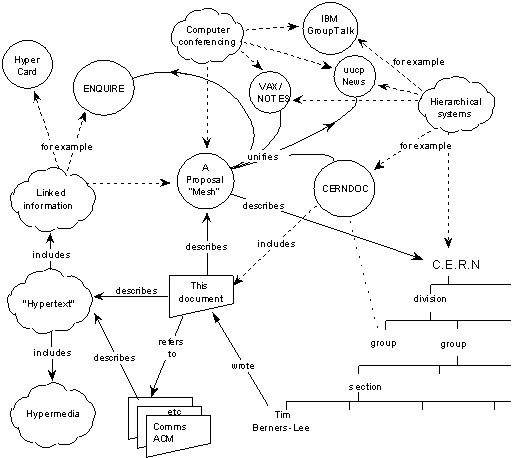
July 1 2011 — Dan Whaley creates Hypothes.is, an open-source software project that aims to collect comments about statements made in any web-accessible content.
* * * * * * * * * * * * * * * * * * * * * * * * * * * * * * * * * * * * * *
02.08.26 - 13:00
Via Annotation
Sam Anderson wrote his 2011 essay What I Really Want Is Someone Rolling Around in the Text, he recalled experiencing annotation as additive, useful, social, a means to collaborate with a text, and as “meta-conversation running in the margins.""
* * * * * * * * * * * * * * * * * * * * * * * * * * * * * * * * * * * * * *
02.08.26 - 13:00 There is no body of marginalia--in English or perhaps in any other language--comparable with Coleridge's in range and variety and in the sensitiveness, scope, and depth of his reaction to what he was reading.
The present volume comprises annotations on 123 books (from authors C to H), including Donne's Poems and Sermons, seven copies of Eichhorn's biblical commentaries, eight volumes of Fichte's works, three Fielding novels and Defoe's Robinson Crusoe, Hegel's Logik, three works of Herder, and eight of Thomas Fuller. Besides English and American works, Coleridge annotated works in German, Latin, Greek, and Italian, the subjects of the volumes encompassing politics, religion, philosophy, poetry, aesthetics, medicine, law, and fiction. Part II also describes seventeen known but lost Coleridge-annotated volumes
Via Annotation
"It wasn’t until 1819 that Samuel Taylor Coleridge first used the term “marginalia,” from the Latin marginalis (or “in the margin”), when, as a literary critic, he wrote about another author’s work for Blackwood’s Magazine.""
Samuel Taylor Coleridge is famous for his extensive use of annotations.
Marginalia I
by Samuel Taylor Coleridge, edited by Goerge Whalle who wrote :

* * * * * * * * * * * * * * * * * * * * * * * * * * * * * * * * * * * * * *
02.08.26 - 12:05
Annotation, is a book by Remi Kalir and
Antero Garcia in The MIT Press Essential Knowledge series.
Annotation—the addition of a note to a text—is an everyday and social activity that provides information, shares commentary, sparks conversation, expresses power, and aids learning. It helps mediate the relationship between reading and writing. This volume in the MIT Press Essential Knowledge series offers an introduction to annotation and its literary, scholarly, civic, and everyday significance across historical and contemporary contexts.
It approaches annotation as a genre—a synthesis of reading, thinking, writing, and communication—and offers examples of annotation that range from medieval rubrication and early book culture to data labeling and online reviews.
Chapter One
On April 18, 2019, a redacted version of the Report On The Investigation Into Russian Interference In The 2016 Presidential Election, by Special Counsel Robert Mueller, was released to the public by the U.S. Department of Justice. Annotation shaped how the report was shared and interpreted.
Journalists annotated the report to provide their readers with information, analysis, and commentary. The Washington Post published a page-by-page analysis titled “The Mueller report, annotated”, NPR offered “Highlights from the Mueller Report, Annotated,” and Politico reporters contributed “An annotated guide to the redacted Mueller report,” among other examples. Annotation across these publications varied in detail, scope, visual style, and interactive features.
Writing to students in 1940, the American philosopher and educator Mortimer Adler declared, “Marking up a book is not an act of mutilation but of love.” Mortimer Adler, “How to Mark a Book,” The Saturday Review, July 6, 1940, 11.
Troy Hicks : Yet, for decades, students have been explicitly told not to damage or otherwise deface their textbooks
In this book, we’ll take an even simpler approach and define annotation as:
A note added to a text.
We’ve settled upon this definition because it gives us flexibility to explore the broad genre of annotation, both handwritten and digital, textual and visual, from different periods of time, and that serve different cultural and civic purposes. You might notice that unlike the standard-bearing dictionaries, our definition does not include the terms “comment” and “explanation,” denoting two annotation purposes. And that’s because, in our assessment, annotation serves five equally important, and sometimes overlapping purposes: Providing information, sharing commentary, expressing power, sparking conversation, and aiding learning.
Annotation is also important because our intertextual interactions with texts cross multiple contexts - the personal, the academic, the professional, and even the commercial and civic: “Printed marginalia, functioning at their most creative level, open doorways specifically, insistently for the purpose of crossing the text-context threshold.” Slights, 687. (Managing readers :
printed marginalia in English Renaissance books /
William W.E. Slights?)
Chapter Two
* * * * * * * * * * * * * * * * * * * * * * * * * * * * * * * * * * * * * *
31.07.26 - 21:25 "It can be used to write linear text containing calls for notes, as well as multi-voice dialogues." The plan is that the comments will be stored in the Internet Archive. Normal use is with a browser plug-in (Chrome) or a bookmarklet (others), and the plan is that links to specific comments will also be viewable without needing a plug-in. The project launched in January 2018, as part of Arizona State University’s celebration of the novel’s 200th anniversary. Even two centuries later, Shelley’s modern myth continues to shape the way people imagine science, technology, and their moral consequences. Frankenbook gives readers the opportunity to trace the scientific, technological, political, and ethical dimensions of the novel, and to learn more about its historical context and enduring legacy.
annotation systems
those tools's marginalia is a writing tool for creating relationships between several columns of text.


Hypothes.is The project is a system which allows annotation of web pages, using comments contributed by individuals and a reputation system for rating the comments.


frankenbook Frankenbook is a collective reading and collaborative annotation experience of the original 1818 text of Frankenstein by Mary Wollstonecraft Shelley.

* * * * * * * * * * * * * * * * * * * * * * * * * * * * * * * * * * * * * *
31.07.26 - 20:00
wikipedia links
the interesting thing with wikipedia footnotes that are allowed because of the digital aspect of it, is the cycling aspect of citation. You can click on a superscript number, it will bring you to the footnote, and you can then click on the symbol next to the footnote and it will bring you back to the part of the text that is cited.
sourced element
 footnote
footnotes in use

popup in use

* * * * * * * * * * * * * * * * * * * * * * * * * * * * * * * * * * * * * *
30.07.26 - 11:00
the spiral as a nonlinear symbol
Unicode Character cham punctuation spiral “꩜” (U+AA5C), in the Cham unicode block.
Cham is a Unicode block containing characters of the Cham script, which is used for writing the Cham language, primarily used for the Eastern dialect in Cambodia and Vietnam.
A separate block for Western Cham, used in Cambodia, was first proposed to Unicode in 2016. wiki/Cham
Unicode Character cyclone "🌀"(U+1F300), in the Miscellaneous Symbols And Pictographs block.
[i don't know why it appears blue by default? like links...]
* * * * * * * * * * * * * * * * * * * * * * * * * * * * * * * * * * * * * *
29.07.26 - 19:20
more* is a workshop by Mindy Seu and Laura Coombs at the Southland Institute.
[After each drawing an asterisk, the symbol of link, they started with Octavia Butler's primitive hypertext : "I generally have four or five books open around the house ..."] The website created was composed of text, quotes, annotations, mp3 and mp4 files, images and links.

"An asterisk gives us more. It adds layers of information to a primary text. It encodes expletives, repairs mistakes, and inserts personal voice. It is an additive gesture. In this Southland Institute workshop, we will co-author and distribute a group publication that amplifies the potential of this glyph.""
the differents asterisks :


i particularly like Rebecca Wilkinson's asterisk. it seemed a mix of an asterisk and the up right arrow that can signify a link.

* + ↗ or * +
* * * * * * * * * * * * * * * * * * * * * * * * * * * * * * * * * * * * * *
29.07.26 - 17:00
Humdrumpress Situational Publishing's an interview with Robina
an interview where two types of annotations appears, commentary/precision from the interviewee and questions from the interviewer and their answers.
* * * * * * * * * * * * * * * * * * * * * * * * * * * * * * * * * * * * * *
28.07.26 - 13:20
"Pseudo Press is a publishing project and bookbindery based in Berlin, founded by Lauria Joan. With a focus on the archival, the ancient, and the apocryphal, Pseudo Press has been alliterating since 2020. Pseudo Press handcrafts and publishes books, zines, and stationery that explore the materiality and history of book-making and book-reading as something communal, precious, and strange."
what i like a lot was that the footnotes, or comments, where placed in a pop up style frame. It plays with the aesthetics of the digital on a printed book. The footnotes superscript numbers are always 404, the error message of a computer.


* * * * * * * * * * * * * * * * * * * * * * * * * * * * * * * * * * * * * *
24.07.26 - 21:06
Wikipedia’s open, collaborative editing structure has
been described as realizing the death of the author and
the birth of the reader as author, blurring the boundary between readership and authorship (de Vugt, 2010).
Wikipedia’s hypertextual wiki structure extends this authorial power to the act of reading itself. When a reader
falls down a Wikipedia rabbit hole, following a curiositydriven trail of links across articles (Piccardi et al., 2022),
reading becomes a form of authorship. Internet artist
Chia Amisola frames this directly, arguing that hypertextual web browsing is a performance of authorship and
creativity (Amisola, 2024). Wikipedia rabbit-holing is
authorship in this sense because readers make choices
about where to linger and which links to follow, producing a path and authoring an experience that is their own. It’s been a long time I wanted to pay tribute to Wikipedia. This invitation by Hato Press was the perfect context to start working on it. It starts with an image from your search term’s Wikipedia page, then follows a series of linked articles, pulling an image from each one. Images at the center of the spiral are directly related to your search term, while those farther out reveal broader, tangential, or more abstract connections to it.
postphotography asignement from december 2023 - january 2024 where i planned out a wikirace from humans to incorporeality and reappropiated the figures from each article and compilated them in a little booklet Stemming from the concept of Wikipedia racing (and a childhood spent playing invented hyperlink games), Sungrazer is a walk through the connective tissue of Wikipedia.
Focusing on memorial, the networked image as marker, and the function of memory and remembrance on a collectively edited internet, this work context-drifts through Wikipedia articles, forming a web of lateral connectivity between topics.
Following links from one article to another as backing slides for the lecture itself, Sungrazer is beholden to every 3 am rabbit hole that leaves you, blinking, the next morning at a window full of tabs and a browser history dense with searching.
wikipedia, made of links
[]
hyperlinks on wikipedia is a compilation of out of context hyperlinks by Zach Rose
wiki talk page as gossip

wikipedia page edit that shows the evolution of the page through the edits

Revisiting the Rabbit Hole: The Hypertextual Friction of Wikipedi by Sophia Liu and Shm Garanganao Almeda
We foreground three key acts in Wikipedia rabbitholing: navigation, interpretation, and curation. Navigation is the act of traversing a hypertext and producing a
traceable path (Liu and Almeda, 2026). Interpretation is
the making of meaning through association and context.
Curation is the deliberate collection and juxtaposition of
concepts as associations form and understanding grows.
Together, these acts constitute the reader-as-author.
While reading a Wikipedia article, one encounters an expanse of text speckled with blue links, each
a potential path to a new article driven by personal curiosity and active choice. By the end of a rabbit-holing
session, a reader has accumulated a collection of interrelated article topics that together form a new understanding
of some aspect of the world. This collection exists first in the reader’s mind, held together by the associations
formed through reading and navigating. Wiki Museum
gives that collection a form, allowing readers to import
a scoped set of Wikipedia pages, add and remove topics
as their understanding evolves, and explore the relationships among them across three coordinated List, Wiki,
and Graph views.
Fungal is a font by
Raphaël Bastide and
Jérémy Landes, here is its official page

This page is a homage to Wikipedia, one of the greatest website of the World Wide Web. This collaborative encyclopedia is now 21 years old, and I am still fascinated how it changed our relationship to knowledge. It also represents a comforting example of what humanity can do: collaborating voluntarily on the largest knowledge project in our history. I consider Wikipedia being the descendant of Enlightenment’s encyclopédistes and free software movement, and I think such project made by the people, for the people are beautiful remains of the early Web’s utopia.
Wikipedia is not perfect (lack of diversity, moderation…) and it remains a fragile system. Still, I wanted to picture it as a post-human vestige, an artifact invaded by biomorphic figures and spreading typography. My work quickly focused on how to create organic ornaments, affecting the encyclopedia’s interface, its typography, the figures and the Wikipedia logo itself.
Wikiracing is a game in which players compete to navigate from one Wikipedia page to another using only the internal links of the page. you can try here!
Spiral Getty by Shaheer Tarar
is a visual research tool that maps out a Wikipedia rabbit hole.
Spiral Getty is made and maintained by Shaheer Tarar. This site is an artistic work within the Web Residencies programme by Akademie Schloss Solitude.
Hyperlinking
humans &
incorporeality by João Bresler
Sungrazer by Everest Pipkin

¶ (Pilcrow) #0 - #4
consists solely of texts and images found on the online collaborative encyclopedia Wikipedia. It is assembled by Jan-Pieter ‘t Hart.
The edition consist of curating and de designing wikipedia pages, i wondered how they would (if at all) make th efootnotes and articles resume appear.


* * * * * * * * * * * * * * * * * * * * * * * * * * * * * * * * * * * * * *
24.07.26 - 20:50
The demicolon
New Punctuation Marks for Grammar Nerds
, by Owen Parsons, on the now non-existent website CollegeHumor via the internet archive.
[It is obviously a fake symbol, with a funny made up story. But i found it intersting that it functionally works like a simultaneity mark. The two (or three) actions written after the symbol can be interpreted as happening at the same time, or be a multiple choice sentence]

* * * * * * * * * * * * * * * * * * * * * * * * * * * * * * * * * * * * * *
24.07.26 - 20:30
i found these drawings of Victoria Bas on her instagram @basvii.
it explores the relationship between medieval illuminations and web ads. There is something there about marginalia, and the way it grabs your attention or disrupt the reading akin to ads. And it's really beautiful, she mentions she made the illutrations for an essay, but i cannot find it online.


* * * * * * * * * * * * * * * * * * * * * * * * * * * * * * * * * * * * * *
24.07.26 - 19:30
The Relational Citation Style by Deborah Khodanovich
(it made me think about the Multidimensional Citation system i discovered a while ago)
[here it is a system of glyphs that help you cite everyone and the way you came by an information]
the website is in construction, but i look forward to it
Co-authorship as a method of relational practices became the forefront of a lot of the work
and thinking I continued to make. Naturally
then the question of attribution began to come
up, in part because I was attempting to keep track of all my conversations to properly cite those who helped in any way along
my process, and in part because of my perception that all I make
has never been made by only me. We are constantly recycling,
reproducing, remixing ideas, and personally claiming any one
thing as entirely my own has always felt icky to me.
Relational Citation Style was a system that grew out of
exactly that
many many dialogues and people who I crossed
paths with. I took an open-source academic font, EB Garamond,
and developed custom glyphs to act as symbolic notation to go
along with superscript in footnotes. The glyphs introduce other
forms of knowledge that can be cited alongside published & copyrighted sources, to legitimize them within existing system
It learns from both feminist and indigenous
citation practices, with an emphasis on generosity and care, and the importance of tracing
lineage. RCS treats oral transmission and
collaborative thinking as legitimate and valuable scholarly sources that should be properly
credited and traced along its lineage.
"The Relational Citation Style Handbook is a small academic book made for librarians and scholarly spaces to distribute for use in the aid of using the system. Like any other citation manual, it dictates all the rules and agreements on how to use the style properly, and how to understand the differences between in-text citations, footnotes, and the sources cited at the end of a research paper."
click to see more


i also discovered in her thesis Just Between Us (and everyone we tell...), that she did at RISD, another edition named How to cite your friends
How to Cite your Friends is a four page broadsheet that calls the public in on understanding the need of this new citation system. The poster formed as a newspaper is exciting and bold, showing how the system works through flipping the hierarchies of the body text and the footnote. The back of the paper borrows from teen magazines, including a fun quiz that can be taken to help someone get started with understanding the different types of citations.


* * * * * * * * * * * * * * * * * * * * * * * * * * * * * * * * * * * * * *
24.07.26 - 17:10
i saw this cover title on instagram of the book TITLE: Unreal (Adobe: Photoshop) 2, by Day Stay Hay


i found it beautiful, but what grabbe my attention was the link symbol used as a letter :

* * * * * * * * * * * * * * * * * * * * * * * * * * * * * * * * * * * * * *
24.07.26 - 15:20
Intertwingled
i realised i never explained what intertwingled means or where it came from. i discovered the word via Ted Nelson : Everything is deeply intertwingled.
Intertwingularity is a portmanteau of the words intertwined and intermingled, [...] to express the dense and interconnected relationships in human knowledge.
First mentioned in Computer Lib/Dream Machines where he states how "everything is deeply intertwingled ... there are no "subjects" at all; there is only all knowledge, since the cross-connections among the myriad topics of this world simply cannot be divided up neatly." Nelson refers to intertwingularity by contrasting it with conventional forms of organization, such as hierarchical classification or sequential organization; he believes that the structural imposition of categories or hierarchy distorts the relations between the things being represented. wiki/Intertwingularity
Whereas Oxford, Mirriam-Webster, Cambridge and other household names dictionnaries said the word simply didn't exist, wiktionary was there for me. It gave me two understandings :1. To confuse or entangle together; to enmesh, to muddle.
Now, having descarded,[sic – meaning discarded] by virtue of the spirit of the lord of universe, the possessions resembling the city of the Gandharvas created by the illusive energy of God which naturally get intertwingled with (one's) soul; go I to seek the protection of Him.
1896, chapter IX, in Manmatha Nath Dutt, transl., A Prose English Translation of Srimadbhagavatam, book IX, Calcutta, West Bengal, page 37

A writer in the Kansas City "Star" has discovered that there is a "Kansas language." […] To the Kansas list we beg to add a New Jersey word, "intertwingle"—as roots do in the soil.]
1917 June 27, “By the Way”, in The Outlook, volume 116, New York,Outlook Co., page 344


The Little Fire Engine. Even if Graham Greene had not come out from the anonymity of The Little Red Engine and signed it, this is surely the Book of the Year. Pathos and humour ‘inextricably intertwingled’. Charlie Chaplin would not have disowned it, and a much younger [Walt] Disney at his best would have envied it.
1950 December, “Children’s Books, Christmas, 1950. A Personal Choice of a Dozen. [book reviews]”, in The New Era in Home and School, volume 31, number 10, page 246:

This is largely an accident of history, but it is also a natural concomitant of the need for coupling urban technological analysis and problem explorations with designed and concrete solutions to social, political, economic, and physical problems of urban areas expressed in physical terms as plans. The fact that all of these elements are, as Tracy Augur says, "inextricably intertwingled" makes for the complex job of the "generalist in planning," in contradistinction to the specialist, let us say, in school architecture, or hospital architecture, or residential architecture.
1954 October, Carl Feiss, “Out of School: City Planning Education as Related to Architectural Education”, in Progressive Architecture, volume XXXV, number 10, archived from the original on 17 April 2024, page 174

Fortunately, these objectives are not only compatible, but are, to use a popular Washington phrase, "inextricably intertwingled."
1958, News of the American Alumni Council, Washington, D.C.: American Alumni Council, page 9
Such a magnetic matrix, plane, or array can function as a serial store. In a 1024-core square array, the X dimension could represent the 32 bit positions of a word and the Y dimension, 32 different words. […] This plane of 1024 cores, so far as organization is concerned, can be thought of as four 32 × 8 arrays intertwingled.
1963, Willis Howard Ware, “The Store”, in Digital Computer Technology and Design, volumes II (Circuits and Machine Design), London: John Wiley and Sons, page 12

The "inextricable intertwingling" of engineering and science and research and development is no better illustrated than in this example of the particle accelerators.
1965, Aerospace Medicine, volume 36, St. Paul, Minn.: Aerospace Medical Association, page 606
I was particularly attracted to her, not only because of her spontaneous eloquence but also because she recognised me as: ‘the gentleman who gets his words all intertwingled’.
1984, Stanley Unwin, Deep Joy: Master of the Sproken Word, Whitby, North Yorkshire: Caedmon of Whitby, →ISBN, page 139:
2. (computing, information science) Of documents, information, etc.: to interconnect or interrelate in a complex way.
But why should things be saved? Everything is deeply intertwingled. We save for knowledge and nostalgia, but what we thought was knowledge often turns to nostalgia, and nostalgia often brings us deeper insights that cut across our lives and very selves.
1974 March, Theodor H[olm] Nelson, “Dream Machines: New Freedoms through Computer Screens—a Minority Report [‘On Writing,’ a Paradigm of the Creative Process]”, in Computer Lib/Dream Machines, South Bend, Ind.: Theodor H. Nelson, published March 1977, page 98

Deeply intertwingled hypertext documents offer readers abundant choices, permitting reader and author to work together to dynamically reorganize the document to meet specific needs.
1991 February, Mark Bernstein, “Deeply Intertwingled Hypertext: The Navigation Problem Reconsidered”, in Technical Communication: Journal of the Society for Technical Communication, volume 38, number 1, Arlington, Society for Technical Communication, page 41

This book, like the conference, is called Intertwingled. It’s a word that expresses a philosophical position about cross-connection. I said in Computer Lib, "Everything is deeply intertwingled." I meant that all subjects and issues are intertwined and intermingled. But intertwingled subjects are not what computers usually represent. From the beginning, people have set computers up to be hierarchical. […] Now, it's also a metaphysic to say, "everything is deeply intertwingled," since the sentence cannot be proven true or false. But it is computer science to say that we need to represent cross-connection, and I’m expressing a computer science opinion when I say that intertwingularity is a better form of representation—for everything—than hierarchy.
2015, Theodor Holm Nelson, “What Box?”, in Douglas R. Dechow, Daniele C. Struppa, editors, Intertwingled: The Work and Influence of Ted Nelson (History of Computing), page 134
[John] Sheridan (2018) argues that the ‘intertwingling’ of records will become commonplace, and records will contextualise each other.
2020, Andrew Prescott, “Community Archives and the Health of the Internet”, in Simon Popple, Andrew Prescott, Daniel H. Mutibwa, editors, Communities, Archives and New Collaborative Practices (Connected Communities),University of Bristol, (Disruptive and Counter Voices: The Community Turn), page 260

* * * * * * * * * * * * * * * * * * * * * * * * * * * * * * * * * * * * * *
22.07.26 - 12:10
It is with this idea in mind that they design Smalltalk, a programming language originally created for educational use. In 1984, Steve Jobs attended a demonstration of the Smalltalk system and Apple used it as the basis for the Apple Macintosh desktop environment. The visual interface is a ‘desktop’ in which folders, a recycle bin, folders, and files are placed. All elements are organized in "windows" that can be expanded, enlarged and moved. Link, Private Use Area (U+E157)
Link 2, Supplementary Private Use Area-A (U+FFFB5)
Link Off, Private Use Area (U+E16F) Add Link, Private Use Area (U+E178) Arrow Outward, Private Use Area (U+F8CE) Box arrow up-left, Private Use Area (U+F1C4) Box arrow up-right, Private Use Area (U+F1C5) Link, Private Use Area (U+F471) Link 45deg, Private Use Area (U+F470)
It encoded constructed scripts, such as Klingon and Ferengi script (Star Trek), Tengwar and Cirth (J.R.R. Tolkien's cursive and runic scripts), Alexander Melville Bell's Visible Speech, and Dr. Seuss's alphabet from On Beyond Zebra.
In medieval texts, many special ligatures, scribal abbreviations, and letter forms existed, which are no longer a part of the Latin alphabet. As few of these characters are encoded in Unicode, ligatures have to be broken up into separate letters when digitized. Since few fonts support medieval ligatures or alternative letter forms, it is difficult to transmit them reliably in digital formats.
An icon is a metaphor, how to represent the link?
"In computers, an icon is a pictogram displayed on a screen
in order to help the user navigate through a computer system." wiki/Icon
These "visual metaphors" are the visuals of software, the trash can
from our computer or the arrow to respond to an email. A
subgroup of these icons is known as the desktop
phor. Its origin dates back to the 1970s, at
Xerox Park, when Adele Goldberg and Alan Kay are carrying out work
on the graphical interfaces. Their motto was "Doing with images makes Symbols" 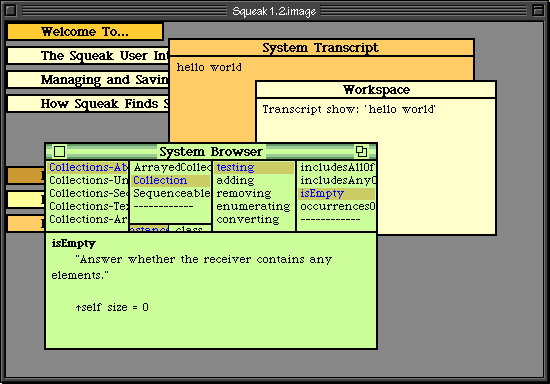
This is skeuomorphism: all these digital elements imitate physical elements, which serve to identify their role. This model was intended to allow users to navigate intuitively on the desktop and computer system. Thus a new language is created, based on icons. Susan Kare is the artist who designed these first icons for Apple Macintosh. She describes her design process as
"A headache to match an icon with a metaphor."
google fonts icons when you search for "link/hyperlink"
bootstrap icons when you search for "link/hyperlink"
We can see that they use the Private Use Area Unicode Block.
[In Unicode, the Private Use Areas are three blocks that are not assigned characters by the standard. They are intentionally left undefined so that third parties may assign their own characters without conflicting with Unicode Standard assignments. Under the Unicode Stability Policy, the Private Use Areas will remain allocated for that purpose in all future Unicode versions.]
We can see with the exemple, that the encoding changes from one to another asset, meaning there is no standardization.
But there have been multiple standardization initiative like :
The ConScript Unicode Registry (not Unicode Consortium affiliated)
[a volunteer project to coordinate the assignment of code points in the Unicode Private Use Areas for the encoding of artificial scripts, such as those for constructed languages. It was founded by John Cowan and Michael Everson in the early 1990s.]
The Medieval Unicode Font Initiative (not Unicode Consortium affiliated)
[The Medieval Unicode Font Initiative is a non-profit workgroup of scholars and font designers who would like to see a common solution to a problem felt by many medieval scholars: the encoding and display of special characters in Medieval texts written in the Latin alphabet.MUFI was founded in July 2001 by a workgroup consisting of Odd Einar Haugen, Alec McAllister, and Tarrin Wills.]
→ I will talk about MUFI again, when i write about signes-de-renvois.
To prevent the possibility of corruption of the source texts, the eventual goal of the MUFI is to create a consensus on which characters to encode, and then present a completed proposal to the Unicode Consortium. In the meantime, a part of the Private Use Area has been assigned for encoding, so these characters can be placed in typefaces for testing and to speed up the later transition to the final encodings (if the project is accepted).
As of September 2017, Junicode is the first typeface to cover all of MUFI 4.0.
The Kurinto Font Folio has two typefaces – Kurinto Book UFI and Kurinto Roma UFI – that cover all of MUFI as of July 5, 2020, including code points added after version 4.0 of MUFI.
There are three typefaces that are confirmed to cover all of MUFI 3.0. These are Cardo, Andron Scriptor Web and Palemonas MUFI.
* * * * * * * * * * * * * * * * * * * * * * * * * * * * * * * * * * * * * *
21.07.26 - 12:50 Paper documents were the original metaphor for the web.
It’s no surprise we started with paper. At the moment of the web’s conception, computers were objects that lived among white-collar office workers. They were pitched as replacements; they would replace your inbox tray, your trundling filing cabinet, and your little yellow pad of sticky notes. Alan Kay made this cultural context clear when he designed the first desktop metaphor at Xerox PARC in the 1970’s.
The purpose of hypertext was always to make up for the deficiencies of paper. Paper cannot easily show connections, has very limited space, and forces an inflexible rectangular arrangement. Hypertext, the generalization of writing, potentially offers many forms of interconnection and presentation beyond what paper allows. But so far the mechanisms, not the users, have been put in control.
The metaphors of the web
Metaphors We Web By,
A history of our metaphorical understanding of the web, by Maggie Appleton
[An essay about ]
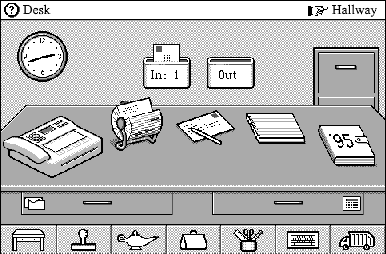
This metaphor of the-web-as-paper works quite well. The otherwise immaterial and abstract nature of the web becomes understandable, familiar, and (most importantly) usable through the paper metaphor. We have all seen, handled, and created our own paper documents – a set of understandings we bring to our behaviour on the web.
I should point out that websites and paper do not share any inherent qualities. We purposefully designed webpages to look like paper, but it wasn’t some inevitable metaphorical fate.
In searching for metaphors that reflect our experiences, we’ve called it a series of tubes , an information superhighway, a surf-able ocean of information, a global village, a town square, and a zero-gravity parallel universe known as cyberspace.
Out of all of these metaphors, the second most dominant after paper is physical space.
This is obvious in the way we speak about the web. Our words describe the web as a sprawling expanse of place-based pages – each piece has in it’s own location we step into when we visit a homepage. We go to websites. They have a permanent address – each URL (uniform resource locator) marks its place in digital space. We follow links and end up on a page, and go back to the previous page.
As George Lakoff and Mark Johnson made clear in their touchstone book Metaphors We Live By, metaphors are the basis of all human thought and reasoning. The metaphors we use to speak about the web are not simply linguistic trivia – they determine how we understand it on a fundamental level. It determines what we think the web is capable of, what risks, opportunities, and challenges it poses. Which means the metaphors we use to think about the web profoundly influence what we think the web is, what we think we can do with it, and how we might change or evolve it.
WAY OUT OF THE BOX, by Theodor Holm Nelson
[A retrospective of the first interfaces (XeroxParc and McIntosh), based on the paper metaphor, albeit a rather mean-spirited one.]
Word processing, spreadsheet, database aren't fundamental, they're just different ideas that different guys have whomped up, ideas that could be totally different in their structure. But these ideas have a plausible air that has set like concrete into a seeming reality. Macintosh and Windows look alike, therefore that must be reality, right?
Wrong. Apple and Windows are like Ford and Chevrolet (or perhaps Tweedledum and Tweedledee), who in their co-imitation create a stereo illusion that seems like reality.
The usual story about Xerox PARC, that they were trying to make the computer understandable to the average man, was a crock. They imitated paper and familiar office machines because that was what the Xerox executives could understand. Xerox was a paper-walloping company, and all other concepts had to be ironed onto paper, like toner, to be even visible in their paper paradigm.
But who cares what Xerox did with their money? That was lab stuff. It was Steve Jobs that turned PARC's work to evil. He took a team from PARC and made a bargain with the Devil, and that bargain with the Devil was called the Macintosh.
Today's arbitrarily constructed computer world is also based on paper simulation, or WYSIWYG. That's where we're stuck in the current model, where most software seems to be mapped to paper. ("WYSIWYG" generally means "What You See is What You Get"-- meaning what you get *when you print it OUT*). In other words, paper is the flat heart of most of today's software concepts.
This too was a key legacy of Xerox PARC. The PARC guys got a lot of points with Xerox management by making the "electronic document" MIMIC PAPER-- rather than extending it outward to include and show all the connections, possibilities, variations, parentheses, conditionals that are really there in the mind of the author or the speaker; rather than presenting all the details that the reporter faces before cooking them down.
I'm not talking about "interfaces". As soon as you agree to talk about the "interface" of something, you've bought into its conceptual structure. I'm talking about something deeper-- new conceptual structures that are not mapped to paper, not divided into hierarchies.
The same goes for "metaphors", in the sense of comparisons to familiar objects like desktops and wastebaskets. As soon as you draw a comparison to something familiar, you are drawn into that comparison-- and stuck with the resemblance. Whereas if you go into free-form design -- free virtualities, as it were-- you are not bound by such comparisons.
There have been a few environments that were abstract and completely different from paper. Raskin's Canon Cat, HyperCard (in its time). My favorite abstract space is Dave Theurer's game of Tempest, which looked like nothing you've ever seen.
Hypertext, as suddenly adapted to the Internet by Berners-Lee and then Andreessen, is still the paper model! Its long rectangular sheets, aptly called "pages", can be escaped only by one-way links. There can be no marginal notes. There can be no annotation (at least not in the deep structure). The Web is the same four-walled prison of paper as the Mac and the Windows PC, with the least possible concession to nonsequential writing ("nonsequential writing" was my original 1965 definition of hypertext) that a sequence-and-hierarchy chauvinist could possibly have made. Whereas the Xanadu Project, our original design which was beaten out by the Web, was largely based on two-way links by which anyone could annotate anything.
BACK TO THE FUTURE:
Hypertext the Way It Used To Be, by Ted Nelson
[]
Here are mechanisms that get in the way:
1. The simulation of paper.
Much of the field has imitated paper: in word processing (Microsoft Word and Adobe Acrobat) and the World Wide Web, whose rectangular page layouts become a focal issue. It should be noted that these systems imitate paper under glass, since you can't annotate it.
The imitation of paper has been enforced by the motto WYSIWYG, "What You See Is What You Get"-- meaning what you get when you print the document out. This simple propagandistic locution legitimizes paper simulation, and printout, as the proper destined objectives of computer documents.
This ignores the more important possibility: how improve on paper? WYSIWYG seems to us absurd: by fetishizing print layout (typeset vertical strips) as the only view of a document, we penalize the user. Any number of views-- and structures-- should be possible.
2. The imitation of physical space.
Extending the imitation of paper, the usual approach to 3D has been "virtual reality"-- the literal imitation of 3D space, where we go beyond imitating the paper to imitating the desk, the room, etc. This extends the same limitations of paper simulation to 3D: everything must be literal, everything must stay the same size in a constant metric. Again, we believe this is very limiting, and has been the reason for the fading of the Virtual Reality movement. The real issue is: how improve on conventional space?
3. Crude links.
At least since the Hypertext Editing System at Brown University in 1968 (10), hypertext links have generally--
- been one-way
- not allowed overlapping of either source or target endsets ("anchors")
- not had types
This crude structure has been a source of regret for which some of us have apologized in print (2). Crude links drastically reduce the types of document, structure and connection that can be represented.
4. Embedded, inextricable hierarchy.
The web formats, including more recently XML and Cascading Style Sheets, are all based on internal hierarchical representation of structure and markup. This further limits the forms of structure which can be represented.
5. Simplistic mapping to files. The standard paradigm of files, unquestioned almost everywhere, drastically affects how everything works. One document is assumed to be one file-- a strange requirement, but it reinforces the one-way linkage restriction currently in place on the World Wide Web. (Since the HTML file contains the links, they can only point outward.)
We believe people accept these limitations because they do not perceive them as limitations, or imagine alternatives.
This is Not my
Beautiful House:
Examining the
Desktop Metaphor,
1980-1995, by Everest Pipkin
[]


Apple popularized the graphical user interface as
we know it today with the release of the Lisa in
1983 and the Apple II in 1984, leaning extremely
heavily on the research from Xerox. After the Xerox
Star and Apple Lisa, dozens of operating systems
were released using this visual strategy within the
next decade.
The Commodore 64’s attempt at user-forward
computing was Magic Desk I, a ROM cartridge that
booted to a particularly illustrative desk sitting in a
drawn office environment. You could move a virtual
hand with the joystick to select between a
typewriter (word processor), a file cabinet (file
system), a clock, and the trash can.
The choice of the office desk as the primary
metaphor for this user revolution says a great deal
about who these new machines were designed for.
After all, those who would directly benefit from the
allusion were those already familiar with the office
environment. These personal computers were
positioned as accessible because they borrowed
directly from the logic of day jobs— but certainly
not everyone’s day job.
For instance, there are no commercial interfaces
that are modeled after working farms, or assembly
lines, or grocers.
* * * * * * * * * * * * * * * * * * * * * * * * * * * * * * * * * * * * * *
21.07.26 - 09:40 The creation and use of the Cyberfeminism Index is a social and political act. It takes the name cyberfeminism as an umbrella, complicates it, and pushes it into plain sight. Edited by designer, professor, and researcher Mindy Seu, it includes more than 700 short entries of radical techno-critical activism in a variety of media, including excerpts from academic articles and scholarly texts; descriptions of hackerspaces, digital rights activist groups, and bio-hacktivism; and depictions of feminist net art and new media art.
The CYBERFEMINISM INDEX is written by Mindy Seuand designed by Laura Coombs. What interest me is the way elements are linked, whith those green numers that call back to another element.


"The website is facilitated and gathered by Mindy Seu. The website was designed in collaboration with and developed by Angeline Meitzler, with frontend support from Janine Rosen and PDF support from Charles Broskoski. The typeface is Arial by Patricia Saunders and Robin Nicholas. Using their metrics, Laura Coombs designed the encircled cross-reference numbers to make a complementary pairing."

* * * * * * * * * * * * * * * * * * * * * * * * * * * * * * * * * * * * * *
20.07.26 - 16:30 At first we felt slightly embarrassed that we had mistaken the source. Although no one seemed to notice, it felt important to amend the citation to reflect the complex relationship of authors linked to the single phrase. The process as we move our eyes from word to word is corrective and revisionary rather than progressive. Each new word revises the complex picture we had before. —Samuel R. Delany 20.07.26 - 16:30 I think you're the guy to ask about this. Why are hyperlinks blue? 20.07.26 - 15:15 TinEye said the first time it was posted was august 2, 2021, on tumblr by f85o, but i couldn't find it, the account is now desactivated
20.07.26 - 10:48 The best-practice method to include custom icons in modern browsers is with inline SVG. This has the
advantage that no external resources need be packaged and it scales like vector fonts. Without the
EXTERNAL LINK () this is the amount of code needed to use this symbol : People who answered this question : here are the three unidode proposals : It is used as a part of the descriptive text the user has to click (or consider) to call the link (mostly
as the first character of that text, sometime as the last character). Thus, it is used as a textual
character within the plain text which constitutes the link description.
The proposed EXTERNAL LINK SIGN marks external links within web pages (i.e. links which lead to
another site, contrary to internal links which lead to another page within the same site or domain).
The proposed INTERNAL LINK SIGN marks internal links within web pages (i.e. links which lead to
another page within the same site or domain). Indeed the external link character is primarily useful in hypertext where markup is available, but as the
following examples will show, it doesn’t follow that a graphical image is a suitable substitution for a
plain-text character "The UTC rejected the proposals to add "external link sign", most recently in L2/12-169. It is unclear that the entity in question is actually an element of plain text, given the inevitable connection to its function in linking to other documents, and thus its coexistence with markup for links. On its own website, the Unicode represent links with the North East Arrow (U+2197) in a "sup" tag.
18.07.26 - 19:20 But I’ve never stopped and wondered, why are links blue? It was just a fact of life. Grass is green and hyperlinks are blue. Elise Blanchard
I think the real reason why we have blue hyperlinks is simply because color monitors were becoming more popular around this time . Mosaic as a product also became popular, and blue hyperlinks went along for the ride. Mosaic came out during an important time where support for color monitors was shifting; the standard was for hyperlinks to use black text with some sort of underline, hover state or border. Don Hopkins, or a commenter who goes by the same name, knew the answer, and pointed me towards Ben Shneiderman. In short, it is a Prof. Ben Shneiderman whom we can thank for the modern blue hyperlink. At the time, however, I didn’t yet know this. I found the professor online, and contacted him, and went about my day. He so kindly reached out to me, and as he spoke, it was an epiphany – all of these disassociated pieces of applications, history and anecdotes suddenly fit together like a marvelous great puzzle. It’s a daunting task to boil down the past ten years of the internet into only ten colors. [...] I subjectively choose some memorable colors directly from websites I’ve designed these past ten years… and I’ve also included some favorites from our collective screen-based unconscious. Before the hyperlinks were underlined black, they were blue without the underline. Before that, an underlined blue as they are now. Before that, I have no idea. But they were something and before that, something else.
When I think of websites where hyperlinks are vital in taking you from one destination to the next, the two sites that come to mind quicker than others are Google and Wikipedia. In 2016, Google experimented with black hyperlinks instead of blue and the Internet lost its mind. After the test, it was back to blue.[...]
18.07.26 - 11:00
Hypertext surpasses ‘traditional’ text. It can do more than just contain its own information because it provides connections to other nodes. Those links allow readers to jump from an anchor to the reference and follow that path that might as well lead away from the ‘main’ text they started at, or jump them between paragraphs within said starting point. Through that, they can explore the context or relationships between the content.
Ted Nelson argues that most of literary culture has already worked as a hypertext system, through referentiality. Page numbers, indexes, footnotes, annotations and bibliographies are the original analogue paper equivalent to links. There is no ingrained central Index or table of content to the Web like we know it from libraries, printed encyclopaedias or the Mundaneum. So besides hyperlinks, how do we actually navigate the Web if not top-down? By algorithm-driven search engines like Google, which have basically replaced typing URLs.
As Ted Nelson seems obsessed with visual links it is worth a mention here, I think opposed to just visually implying there is an underlying connection, his definition of ‘visual’ implies showing the connected source link right next to where it was implemented, so it’s always put in context. This idea is very close to the two-display concept introduced by Bush but doesn’t seem to have caught on.
17.07.26 - 16:00 History Specifics Features History Specifics Features History Specifics Features History Specifics Features History Specifics Features History Specifics Features History Specifics Features History Specifics Features History Specifics Features History Specifics Features History Specifics Features History Specifics Features History Specifics Features History Specifics Features History Specifics Features History Specifics Features History Specifics Features History Specifics Features 17.07.26 - 14:40 Judy was a poet who wrote FORTRAN as elegantly as verse; Cathy an engineer with an English degree. Judy used databases to string together fragments of literature. At PARC, Cathy built systems to organize thought. [...] Sitting in white plastic chairs, they talked. And talked. Cathy and Judy lobbied PARC administration to officially recognize their collaboration, and when their bid was accepted they became the first two women to be paired by PARC’s Artist-in-Residence program. Several times a week, Cathy and Judy exchanged short screenfuls of text via email. The literary hypertext world has a name, “lexia,” for such chunks of text, but Cathy and Judy called them “screens.” Each was related to the last by association alone, following threads that began with their conversation in the garden: childhood, family, work, love. Receiving a screen, each would respond with whatever sparked their memory, often making the connection between a screen and the response it garnered so tangential as to earn the aura of mystery. "even worse, that day, senior Xerox brass—the “funders”—were lurking the hallways, putting everyone on edge. “Too corporate,” Cathy wrote. “Too metal and glass.” Cathy showed Judy VIKI, a spatial hypertext system she was building that allowed for soft, implicit associations between ideas. Judy commented on the system’s colors, then hurried to the next stop, dripping pea juice and blood." When data of any sort are placed in storage, they are filed alphabetically or numerically and information is found (when it is by tracing it down from subclass to subclass. It can be in only one place, unless duplicates are used; one has to have rules as to which path will locate it, and the rules are cumbersome. Having found one item, moreover, one has to emerge from the system and re-enter on a new path. The human mind does not work that way. It operates by association. With one item in its its grasp, it snaps instantly to the next that is suggested by the association of thoughts, in accordance with some intricate web of trails carried by the cells of the brain. It has other characteristics, of course; trails that are not frequently followed are prone to fade, items are not fully permanent, memory is transitory. Yet the speed of action, the intricacy of trails, the detail of mental pictures, is awe-inspiring beyond all else in nature. Consider a future device for individual use, which is a sort of mechanized private file and library. It needs a name, and to coin one at random, "memex" will do. A memex is a device in which an individual stores all his books, records and communications, and which is mechanized so that it may be consulted with exceeding speed and flexibility. It is an enlarged intimate supplement to his memory. Bush was right. His famous article is, however, generally
misinterpreted, for it has little to do with "information retrieval" as
prosecuted today. Bush rejected indexing and discussed instead new forms
of documents.
It is possible that Bush's vision will be fulfilled substantially as
he saw it, and that information retrieval systems of the kinds now popular
will see less use than anticipated.
As the technological base has changed, we must recast his thesis
slightly, and regard Bush's "memex" as three things: the personal
presentation, editing and file console; a digital feeder network for the
delivery of documents in full-text digital form; and new types of
documents, or hypertexts, which are especially worth receiving and sending
in this manner.
In addition, we also consider a likely design for specialist
hypertexts, and discuss problems of their publicati.on. It is strange that "As We May Think" has been taken so to heart in the
field of information retrieval, since it runs counter to virtually all work
being pursued under the name of information retrieval today. Such-systems
are principally concerned either with indexing conventional documents by
content, or with somehow representing that content in a way that can be
mec:tianically searched and deciphered. The best current definition of hypertext, over quite a broad range
of types, is "text structure that cannot be conveniently printed." This
is not very specific or profound, but it fits best.
As Bush pointed out in his own terms, we think in hypertext (106,
col. 2). We have been speaking hypertext all our lives and never known it.
It is usually only in writing that we must pick thoughts up and irrelevantly put them down in the sequence demanded by the printed word.
Writing is a process of making the tree of thought into a picket fence.
Hypertext structures are varied, For instance, they may be freebranching with only one type of link and backing up; they may have modal
links with different meanings in a free structure; or have modal links and
repetitive structure. Judy was a poet who wrote FORTRAN as elegantly as verse; Cathy an engineer with an English degree. Judy used databases to string together fragments of literature. At PARC, Cathy built systems to organize thought. [...] Sitting in white plastic chairs, they talked. And talked. Cathy and Judy lobbied PARC administration to officially recognize their collaboration, and when their bid was accepted they became the first two women to be paired by PARC’s Artist-in-Residence program. Several times a week, Cathy and Judy exchanged short screenfuls of text via email. The literary hypertext world has a name, “lexia,” for such chunks of text, but Cathy and Judy called them “screens.” Each was related to the last by association alone, following threads that began with their conversation in the garden: childhood, family, work, love. Receiving a screen, each would respond with whatever sparked their memory, often making the connection between a screen and the response it garnered so tangential as to earn the aura of mystery. "even worse, that day, senior Xerox brass—the “funders”—were lurking the hallways, putting everyone on edge. “Too corporate,” Cathy wrote. “Too metal and glass.” Cathy showed Judy VIKI, a spatial hypertext system she was building that allowed for soft, implicit associations between ideas. Judy commented on the system’s colors, then hurried to the next stop, dripping pea juice and blood." One of the first steps you take when creating a website is choosing a domain name. The domain name becomes your presence, a point of access; you are a site that people may recognize, are welcome to visit, one that is real. I took as many names as I did selves: destinyzbond.webs.com, cirrumilus.sky-song.org, belovedhearts.webs.com, each a name to my stories, a place to fill, a becoming.
A website is a site of potential. A domain isn't only a name, it is an invitation to start something new. Websites have always functioned to me as translations and fragmentations of myself, ways to give form to myself through constantly re-situating and re-contextualizing across the internet. The act of construction is a practice of making the self (rather than just a re-presentation): filling a domain is assembling a new body for the self, with the site as an extension of the body, or a distillation and compression of itoften making the connection between a screen and the response it garnered so tangential as to earn the aura of mystery. Domain naming invites us to inhabit worlds so emergent and unnamed, that to refer to things, we might only be able to point. Language is laggy, boundless, bounded, overlapping, constrained, situated, uttered anywhere, everywhere, embedded, becoming. Extending ourselves onto a website might not only be an interior, individual practice of preservation, but part of a broader non-linear history that welcomes many visibilities, each with countless lines and opacities. It was one thing to hide in the back-rooms of Xerox Palo Alto Research Center decades ago, launching innovations as the hidden-hand behind the VLSI microelectronics revolution in Silicon Valley - a revolution that's changed the world forever. I didn't mind being almost invisible in my field back then or that no one had a clue what I was really doing, much less who was doing it. I was thrilled to even have a job.
But 'out' has many shades of grey -- and even in recent years I kept on partly covering, shyly holding back, lingering in the darker shadows. Although times had changed, I'd clung to old habits.
Down through the years no one could explain how the VLSI revolution actually happened. The results were simply taken for granted. Although I'd gained vital knowledge about generating such engineering paradigm shifts, I feared that my personal history would loom large in people's minds, and obscure any attempts at explanation. It wasn't till 2012 that I finally got up the nerve to publish a career memoir, to begin telling the story of how the revolution came about ... All texts, in a sense, are hypertext. You come to a word you don't understand, so you look it up in the dictionary. You read a passage and you stop and you think about another book; you may even put it down and go get another book off your bookshelf and read something about something else. Texts are not linear. Texts are multiple and for anybody who really reads and enjoys reading, it is an interactive process. [Delany] What hypertext and the interactive material do is make that a much less energy-intensive process; as such, on the absolute scale, they are less interactive than the ones we've got now because in order to interact with the ones you've got now, you have to put out more energy. Now I think something is gained by having the interactivity require less energy. It becomes a medium in itself that's interestingly exploitable. [Delany] I generally have four or five books open around the house--I live alone; I can do this--and they are not books on the same subject. They don't relate to each other in any particular way, and the ideas they present bounce off one another. And I like this effect. I also listen to audio-books, and I'll go out for my morning walk with tapes from two very different audio-books, and let those ideas bounce off each other, simmer, reproduce in some odd way, so that I come up with ideas that I might not have come up with if I had simply stuck to one book until I was done with it and then gone and picked up another.
So, I guess, in that way, I'm using a kind of primitive hypertext. [Butler] The concept of cybertext focuses on the mechanical organization of the text, by positing
the intricacies of the medium as an integral part of the literary exchange. However, it
also centers attention on the consumer, or user, of the text, as a more integrated figure
than even reader-response theorists would claim. The performance of their reader
takes place all in his head, while the user of cybertext also performs in an
extranoematic sense. During the cybertextual process, the user will have effectuated a
semiotic sequence, and this selective movement is a work of physical construction that
the various concepts of "reading" do not account for. This phenomenon I call ergodic, using a term appropriated from physics that derives from the Greek words ergon and
hodos, meaning "work" and "path." In ergodic literature, nontrivial effort is required to
allow the reader to traverse the text. If ergodic literature is to make sense as a concept,
there must also be nonergodic literature, where the effort to traverse the text is trivial,
with no extranoematic responsibilities placed on the reader except (for example) eye
movement and the periodic or arbitrary turning of pages. In the current discussions of "computer literacy," hypertext, "electronic language," and
so on, there seems to emerge an explicit distinction between the printed, or paperbased, text and the electronic text, both with singular and remarkably opposing
qualities. The arguments for this distinction are sometimes historical, sometimes
technological, but eminently political; that is, they don't focus on what these textual
genres or modes are but on their assumed functional difference from each other. Such
a strategy is useful for drawing attention to, but less so for the analysis of, the objects
thus constructed. It might have been tempting to follow this rhetoric in my investigation
of the concept of cybertext and to describe a dichotomy between it and traditional,
conventional literature; but the meaning of these concepts is unstable to the point of
incoherence, and my construct would therefore probably have reached a similar degree
of uselessness. You're not where you think you are. In hypertext, everything is there at once and equally weighted. It is a body whose brain is dispersed throughout the cells, fraught with potential, fragile with indecision, or rather strong in foregoing decisions, the way a vine will bend but a tree can fall down. It is always at its end and always at its beginning, the birth and the death are simultaneous and reflect each other harmoniously, it is like living in the cemetary and the hospital at once, it is easy to see the white rectangles of hospital beds and the white rectangles of gravestones and the white rectangles of pages as being essentially synonymous. A hypertext never seems quite finished, it isn't clear just where it ends, it's fuzzy at the edges, you can't figure out what matters and what doesn't, what's matter and what's void, what's the bone and what's the flesh, it's all decoration or it's all substance. Normally when you read you can orient yourself by a few important facts and let the details fall where they may. The noun trumps the adjective, person trumps place, idea trumps example. In hypertext, you can't find out what's important so you have to pay attention to everything, which is exhausting like being in a foreign country, you are not native. Writing hypertext, you've got to accept the possibility your reader will just stop reading. Why not? The choice to go do something else might be the best outcome of a text. Who wants a numb reader/reader-by-numbers anyway? Go write your own text. Go paint a mural. You must change your life. I want piratical readers, plagiarists and opportunists, who take what they want from my ideas and knot it into their own arguments. Or even their own novels. From which, possibly, I'll steal it back.
t associations between ideas. Judy commented on the system’s colors, then hurried to the next stop, dripping pea juice and blood." At the dawn of personal computer the user was the center of attention. The user did not develop in parallel with the computer, but prior to it. Think about Vanevar Bush’s “As we May Think” (1945), one of the most influential texts in computer culture. Bush spends more words describing the person who would use the Memex than the Memex itself. He described a scientists of the future, a superman. He, the user of the Memex, not the Memex, itself was heading the article.8 C20 years later, Douglas Engelbart, inventor of the pioneering personal computer system NLS, as well as hypertext, and the mouse, talked about his research on the augmentation of human intellect as “bootstraping” — meaning that human beings, and their brains and bodies, will evolve along with new technology. This is how French sociologist Thierry Bardini describes this approach in his book about Douglas Engelbart: “Engelbart wasn’t interested in just building the personal computer. He was interested in building the person who could use the computer to manage increasing complexity efficiently.” It is very kind advice (and one of the most reasonable books on interface design, btw) and can be translated roughly as “hey, front end developers, don’t assume that your users are more stupid than you, they are just busy.” But it is more than this. What the second part of this quote gets to so importantly is that Users are people who are very busy with something else. The history of the Internet is a variation on this theme – the internet’s size and complexity required the work of many, but the one man whose work is responsible for the web arriving several decades earlier than it otherwise would have regards its design as a failure. This is not to say that the internet we have today is not impressive or powerful, but as Ted Nelson writes in a newly-released publication of his 2002 Ph.D. thesis “Philosophy of Hypertext”, today’s internet is tied to bad philosophy – backward ways of thinking that limit its potential. Ultimately, the world wide web is informed by the philosophical and technical constraints of the past, resulting in a distorted media platform. Nelson wrote widely about Xanadu® — his proposed network of electronic documents — starting in the 1960s and 1970s, but the company that was commercializing his system in the 1980s fell under financial pressure and a simplified version — the world wide web — was adopted instead. Now, years later, Ted Nelson is still advocating a system, very much like his original proposal from the 1960s and 1970s. Nelson's system argues for:
a built-in copyright meter to compensate creators,
permanent, granular addresses to prevent broken links and allow granular annotation and remixing; and
a browser that displays more than one page at a time, to allow readers to navigate more complex works without being disoriented by having to follow links away from the main piece they are reading.
Some readers will notice that up until this point, I’ve been conflating two terms — the “internet”, and the “world wide web”. Strictly speaking, the two are not the same. When most people think about the “internet”, they usually do not distinguish between the “world wide web” and “the internet”. One can think of “the internet” as the universe of connected computers, while “the web” represents those parts of the internet that can be accessed through a web browser like Internet Explorer, Safari, Firefox, or Chrome.
RESEARCH BLOG ON HYPERTEXT AND ITS VISUALIZATION
hypertext counter : 105 logs 21.07.26 20.07.26 18.07.26 17.07.26 16.07.26
three little dots
two marks of non-linearity that are three little dots :
⋱ Multidimensional Citation
Multidimensional Citation is a concept i discovered in this article by Laurel Schwulst
, Laura Coombs and Mindy Seu originally published in
The Serving Library in 2022.
[On the The Multidimensional Citation Mark "⋱", represent the learning trail to an idea. The persons that contributed, who helped arrive at the quote.]

With this gesture, our symbol became what we’ve taken to calling a “multidimensional citation,” a way of tracing not only the source of a quote but the learning trail that supports and surrounds it. While we realize ⋱ is not multidimensional, operating linearly on the printed page, the phrase “multidimensional” captured the mysterious quality we felt when imagining a more expansive citational practice. A citation should not be singular, but instead explicitly connected to the lineage of research that came before it.
Looking at the three names again, we asked ourselves, “Who is missing?” The citation could also acknowledge the people who brought this material to our attention, who might otherwise be left out in a traditional footnote.
Our mark (⋱) is similar to an ellipsis (…). When used within a quotation, an ellipsis depicts something omitted. Relatedly, ⋱ can be thought of as a prompt that asks, “Who is missing?” Through its form, ⋱ also acknowledges its imperfection. Listing a few names may not come close to recording the vastness of the network of people who helped surface an idea, but it’s a start. In other words, ⋱ is not necessarily a call to look up each person cited, but rather an acknowledgment that no one comes to an idea alone.
Both brown and Butler demonstrate how research actually takes place. Instead of obfuscating their references, they share them, acknowledging multiple sources, academic or otherwise. In their work, many influences come together to help form something new, and it’s often most productive if these come from very different sources. We appreciated this generosity. They revealed and acknowledged their learning trails. They didn’t try to take credit for an ongoing lineage because their work is stronger and more accessible by including them.
Productive questions came to mind: Who came before us? How can we acknowledge them and use their work to create something new? We realized a formal connection with our symbol of the three dots:
. Past
. Present
. Future
We later learned that in the Unicode standard, our symbol ⋱ is formally called the “Down Right Diagonal Ellipsis” (U+22F1). We explored the roots of its mathematical origin, here pictured in a matrix. When the ⋱ appears in a matrix, it functions like an ellipsis, but trailing in another direction. In this mathematical context, the ⋱ means “and so forth.” More specifically, the matrix pictured above is called an “identity matrix.”
⋮ Samuel R. Delany’s Simultaneity Mark
The Simultaneity Mark is a symbol i discovered in this article by Bryce Wilner
[On the The Simultaneity Mark "⋮", created by Samuel Delany, indicates that what happens on both sides of the mark happens on the same time.]
In a journal from 1973, at the end of a long meditation on language’s tendency to enforce binaries, he proposes the following:
You cannot make a logical language: you can merely revise language to make it model more or less reasonably a given empirical picture of reality. We have had, in the last hundred years, many radical revisions in our empirical reality picture. We will probably have to have some radical language revisions soon if language is not to fall into complete uselessness and untrustworthiness in a way only hinted at by the McLuhans and the Marcuses.
Three or more language revisions:
[...]
5. Simultaneous punctuation mark “ ⋮ ”
I made a specific note of the fifth item in Delany’s list. I found another mention of it in a different journal from the same year, just before an essay he wrote on his frustration with cybernetics’ approach to linguistic modeling:
A simultaneity mark: “ ⋮ ” means that narrative time has stopped and what happens on both sides of the mark are simultaneous.
In mathematics, “ ⋮ ”—also known as “vertical ellipsis”—is typically reserved for marking a missing term in a matrix that reads from top to bottom. Where a single value is unknown or general duration to be suggested, the three vertical dots will appear. With the invented application he suggests for this mark, Delany proposes an impossibility: that the reader take in two or more actions in the English language’s typical left-to-right reading order, but, in recognizing the mark separating these actions, understand that they occur in perfect sync with one another, and not side-by-side in a narrative timeline. This proposal raises some immediate questions: How does one denote durations of these two discrete actions? Does “ ⋮ ” signify that the two actions surrounding it are of the exact same duration? Is it possible to place this mark between three, four, five, or more actions? What if it replaced all the periods in a text? How could a text that prioritizes simultaneity be read aloud? Would a text written with this mark degrade or enrich narrative? Is linear narrative necessary?
In addition to its narrative function, a simultaneity mark might help visualize multiple, contradictory ideas within an author’s mind, or to provoke skepticism about the hierarchy of a left-to-right reading system. It’s a general narrative expectation that texts follow a logical progression and work toward a conclusion, organizing the things that have been going on such that the reader can see them resolved and then stop thinking about them. Simultaneity might serve as an admission that many events worth writing about simply don’t conform to narrative logic. The compression of time implied by the simultaneity mark is an acknowledgement of the compromises that authors often make to translate actions into written sentences. * * * * * * * * * * * * * * * * * * * * * * * * * * * * * * * * * * * * * *
Marc Andreessen explains why hyperlinks are blue, in an interview with David Perell.
 I feel like i have to talk about it because Marc Andreessen was the cofounder of Mosaic.
But i also have to mention he is an awful human being, so it pains me.
here is the transcript of the interview clip

Cuz I like blue.
Is that why?
Yes. A nice firm color. It's easy to see.
So what's the story here?
You're sitting in an office. It had to be some color.
What' you do? You just had to go into the hex code and you wrote six numbers and letters?
So at the time we were doing this, you know, we tend to forget, a lot of a lot of graphics computers at that time only had 256 total colors. They had some 8bit color 8 bit color palette. Um, and so you can kind of see all 256 colors and it's kind
of like take your take your pick. And so they could have been salmon. Right. Or yellow. I mean, they they had to be something that like actually stood out on the page. Um, and so it was basically going to be blue, red, purple, green. I don't like those other colors.
That's crazy.
By by the way, I also I didn't quite get this across. The other thing I did was I don't like reading text on white backgrounds because my my eyes are a little sensitive to light. Um, and so the if you look at early mosaic and escape, the backgrounds are always gray.
And so it was black text on gray backgrounds. And I used to get a lot of black for that. But what I what I was what I was what I really wanted was dark mode. Um, but I couldn't get there at that point because the displays weren't
et 9 secondesgood enough to do black white text on black backgrounds back then was hard to read because you didn't have enough shades of gray and you couldn't quite get the you didn't have screen
resolution to have that be a appealing thing.
* * * * * * * * * * * * * * * * * * * * * * * * * * * * * * * * * * * * * *
when i thing of links, i think of this image. i don't remember when i first saw it but it was everywhere.
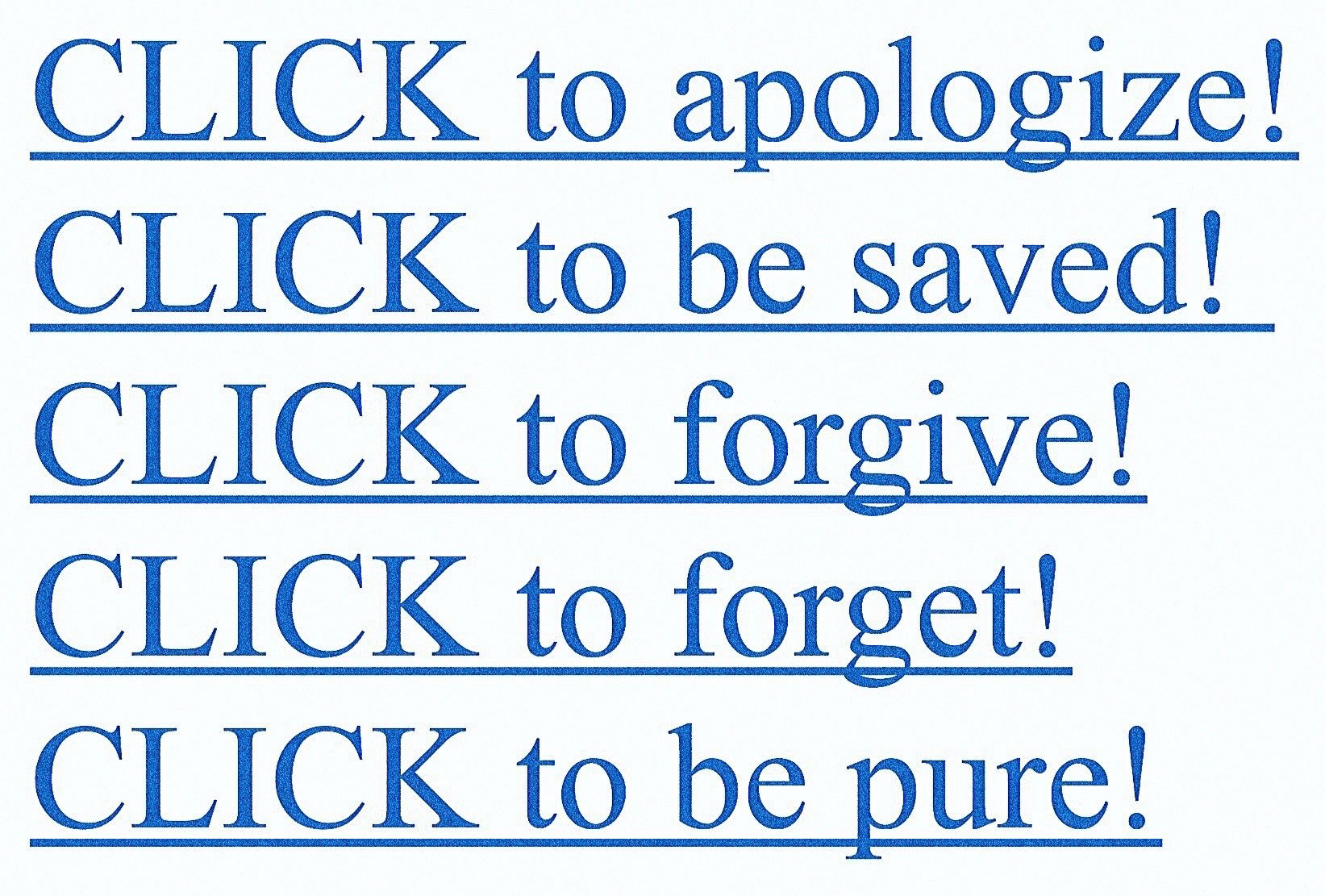
google reverse image search : "About this image
No results were found to help you learn more about this image.
This could be because it's private, very new, or doesn't appear on many pages."
Visual Origins Detector and FindSource didn't find anything either. i think i'm going to try on reddit, i have to make an account.
* * * * * * * * * * * * * * * * * * * * * * * * * * * * * * * * * * * * * *
Once i tried to copy/paste a source from wikipedia, and i noticed an extraspace appeared in my text document. I went back and saw that the link symbol, always used at the end of Wikipedia citation, couldnt be selected. I wondered why and tried to see why it didn't exist in the Unicode. It seemed absurd.
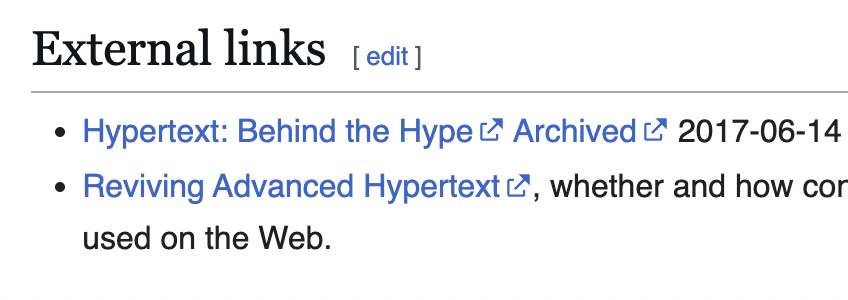
• Why isn't the external link symbol in Unicode? comments (2020) by Hacker News a discussion forum about the relevance of the EXTERNAL LINK SIGN
Proposal to encode an EXTERNAL LINK SIGN in the BMP made in 2006 by Karl Pentzlin (one of the best website design i've ever seen)
[This is the first ever proposal to encode the External Link Sign, Pentzlin argues it is already widespread on the internet, and that it would benefit to be standardised]
The designs shown below (see "specimens") all show a design which fits into the text, having a
height comparable to the ascent of the default font as long as the default font size in common
HTML viewers is used. The symbol is also commonly used within running text. This shows it is
used like a character, and thus deserves to be encoded as a character, rather than to be
standardized as a graphical icon which cannot be assumed to fit universally into running text.
In its essence, the EXTERNAL LINK SIGN symbol is a rectangle with an arrow starting from its
center, with the arrowhead outside. The rectangle usually has a gap, dent or sloping where the
arrow crosses it.
Proposal to encode signs for external and internal links made in 2012 by Karl Pentzlin again.
[6 years later, Pentzlin tried again. This time, the proposition also included an INTERNAL LINK SIGN for internal links inside webpages.]
As the symbol occurs only as part of a text (unlike e.g. the aforementioned "previous" or "home"
symbols), they are no pure "icons" which carry their meaning by itself (like e.g. a traffic sign). They are an
integral part of the text which they denote (the link description), like a TRADE MARK SIGN does not occur
without the text which it denotes (the trade mark name).
Thus, they are characters rather than icons.
In its essence, the EXTERNAL LINK SIGN symbol is a rectangle with an arrow starting from its center,
with the arrowhead outside. The rectangle usually has a gap, dent or sloping where the arrow crosses it.
The reference glyph above shows a single-stemmed arrow pointing diagonally upward ("north-east").
Glyph variants show a double-stemmed arrow (e.g. at Wikipedia) or an arrow pointing rightward (see
specimens).
Revised EXTERNAL LINK Proposal made in 2018 by Devin Bayer (ironically, he is also responsable for the Flying Disc Emoji Proposal which was accepted)
[The third proposal does not repeat all of the points made before in favor of including the symbol in the Unicode, but rather addresses the concerns cited for the first two refusals. It also proposes a mirror version for right-to-left scripts like is already done in wikipedia for exemple.]
Pros (6 apply)
+ is typically used as part of computer
applications (e.g. CAD symbols)
+ has well defined user community / usage
+ always occurs together with text or numbers
(unit, currency, estimated)
must be searchable or indexable
is customarily used in tabular lists as
shorthand for characteristics (e.g. check
mark, maru etc.)
is part of a notational system
+ has well-defined semantics
+ has semantics that lend themselves to
computer processing
completes a class of symbols already in the
standard
+ is letterlike (i.e. should vary with the
surrounding font style)
Cons (0 apply)
the symbol is primarily used freestanding
(traffic signs)
the notational system is not widely used on
computers (dance notation, traffic signs)
the symbol is part of a set undergoing rapid
changes
the symbol is trademarked (unless requested
by the owner) (logos, Der grüne Punkt, CE
symbol, UL symbol, etc)
is purely decorative
it’s ok to ignore its identity in processing
font shifting is the preferred access and the
user community is happy with it (logos, etc.)
In its essence, EXTERNAL LINK is a box with an arrow starting from its center, pointing pointing
“north-east”. The arrowhead is outside. The box has a gap in the corner where the arrow crosses it. The
proposed character is not part of any script and the precise form of their drawing is not critical.
It’s probably more appropriate to reverse the direction of the symbol for right-to-left scripts, since the
arrow should be pointing away from the link name.
→ Official statement by the Unicode Technical Committee in the Archive of Notices of Non-Approval :
Furthermore, the existing widespread practice of representing this sign on web pages using images (often specified via CSS styles) would be unlikely to benefit from attempting to encode a character for this image. (This notice of non-approval should not be construed as precluding alternate proposals which might propose encoding a simple shape-based symbol or symbols similar in appearance to the images used for external link signs, should an appropriate plain-text argument for the need to encode such a simple graphic symbol be forthcoming.) References to UTC Minutes: [131-C26], May 10, 2012." Sup is for superscript text, Superscript text appears half a character above the normal line like this : this text is written in a superscript tag
* * * * * * * * * * * * * * * * * * * * * * * * * * * * * * * * * * * * * *
 a screenshot of a Tumlr post by @popipoyan-deactivated20240919 and @headspace-hotel
it reminded me i previously searched for the answer to the famous question : why are links blue?
here is a list of what i found so far :
Why are hyperlinks blue? by Elise Blanchard
[a kind of an investigation on why they're blue, and a timeline of the different appearances that links took over time]
Mosaic chose to use blue, and they chose to port their browser for multiple operating systems. This helped Mosaic become the standard browser for internet use, and helped solidify its user interface as the default language for interacting with the web.
When Netscape and Internet Explorer were created, the blue hyperlink was already synonymous with the web and interaction. The blue link was now browser-agnostic and well on its way to becoming a symbol of what it means to use the internet.
and i've just found out now, she wrote a follow up : Revisiting why hyperlinks are blue
[which is a retranscription of her talk with Ben Shneiderman]
“Red highlighting made the links more visible, but reduced the user’s capacity to read and retain the content of the text… blue was visible, on both white and black backgrounds and didn’t interfere with retention,” Shneiderman shared with me.
In the late 1980s, industry workshops and conferences brought people together to share ideas, discuss trends and standardize ways of making the web work. What are the results of this sharing of knowledge? Well, hypertext starts to turn blue. At the time, hypertext was more than what we now know as hyperlinks, but also included user interface elements such as the close icon, navigating back and forth between sections, and printing. As we see above, there were arguments from ind
In Laurel Schwulst's Decade in Internet
[she explores 10 iconic internet colors including the very specific blue.]
saint patrick blue
The hyperlink isn’t completely dead (yet). On https://wikipedia.org, blue links continue glowing with mystery—this specific midnight blue is the site’s visited link color. http://craigslist.org also still sports the blue hyperlink—its main navigational beacon. The http://are.na logo blue is nearby—two stars purposefully connected by humans. And quite similar is the night mode on http://artistsspace.org, activated after New York City’s sunset, conveying unknown depths, but still welcome to… and built by… conscious humans. Which reminds us of realms they haven’t yet explored fully… the deep ocean, outer space, and sleep.
Jeffrey Pillow's My Unwavering Love for the Blue Hyperlink
[a love letter to the hyperlink, and an exploration of the other ways they are commonly displayed, like underlined in black]
The other site I mentioned is Wikipedia. Here’s a link to their Hyperlink reference page. Like Google, Wikipedia utilizes the blue hyperlink. It’s a visual cue a word or phrase in this specific color will take you to another Wikipedia page. Interestingly, neither Google or Wikipedia include the once traditional underline.
Because when it comes to hyperlinks, blue it is for me.
“You’re my boy, Blue!” * * * * * * * * * * * * * * * * * * * * * * * * * * * * * * * * * * * * * *
Yesterday I linked a lot the project Linking nodes, the M.F.A. thesis of Miriam Humm. She wrote it at the University of Fine Arts in Hamburg in 2022. Titled "Systems of Hypertextual Knowledge Transfer on a Way Towards a World Brain. A Trail of Thoughts", it is a fascinating exploration of the human attempt of linking information. It was my introdution to a lot of hypertext system i did not know.
Since hyper- generally means "above, beyond", hypertext is something that’s gone beyond the limitations of ordinary text. Thus, unlike the text in a book, hypertext permits you, by clicking with a mouse, to immediately access text in one of millions of different electronic sources.
(Merriam-Webster)
A great advantage of digital text is being able to perform a full-text search, but the computing power needed just wasn’t there with early hypertext systems. I found that Intermedia must have already implemented a similar algorithm but seems to be the only system researched that advertised search as a feature. It seems like the trailblazers didn’t quite grasp the full power search could unleash.
Last but not least Alex Wright brings up an interesting idea that resonates a bit with how FRESS was set up and Otlet’s Universal Decimal Classification. In a Google Tech Talk, he explains that links could also carry a meaning, he calls it gradation of links, which could imply the relationship between the two nodes, if they agree or disagree etcetera. We already know of a similar adoption in FRESS, where links could be tagged with keywords. Maybe something similar is thinkable using classes or IDs in HTML.
People can easily fall into the belief that the web is ‘done’, but there are tons of things, like links that don’t break, that existed in Brown’s systems in the past and hopefully will find their way into the web of the future
(Brown CS: A Half-Century Of Hypertext, n.d.) * * * * * * * * * * * * * * * * * * * * * * * * * * * * * * * * * * * * * *
attempt of a timeline of hypertexts systems [in progress]
1966 / XANADU / USA - Harvard
" Project Xanadu was the first hypertext project, founded in 1960 by Ted Nelson. Administrators of Project Xanadu declared it superior to the World Wide Web, with the mission statement: "Today's popular software simulates paper. The World Wide Web (another imitation of paper) trivialises our original hypertext model with one-way ever-breaking links and no management of version or contents."[2]
wiki/Project_Xanadu
Ted had coined the word hypertext in 1963 to mean “non-sequential writing”, and in 1966, had proposed a system called Xanadu in which he wanted to include features such as linking, conditional branching, windows, indexing, undo, versioning, and comparison of related texts on an interactive graphics screen.
A Half-Century Of Hypertext via Linking nodes
1967 / HES (Hypertext Editing System) / USA - Brown University
The Hypertext Editing System, or HES, was an early hypertext research project conducted at Brown University in 1967 by Andries van Dam, Ted Nelson, and several Brown students.[1] It was the first hypertext system available on commercial equipment that novices could use.[2] wiki/Hypertext_Editing_System
HES organized data into two main types: links and branching text. The branching text could automatically be arranged into menus, and a point within a given area could also have an assigned name, called a label, and be accessed later by that name from the screen. Although HES pioneered many modern hypertext concepts, its emphasis was on text formatting and printing. Ted Nelson & Andries van Dam Develop the First Hypertext Editing System
1968 / NLS (oN-Line System) / USA - Stanford Research Institute
The oN-Line System or short NLS was developed by Douglas Engelbart at the Stanford Research Center, with the intention to provide a tool to sharpen human intelligence to solve the world’s problems. Its presentation in 1968 would go down in history as “The Mother of all Demos”. Inspired by Bush’s article as a soldier in the cold war, Engelbart dedicated his life to information systems, organising and providing easy access to human knowledge.
Linking Nodes
In 1968, he used his “Mother of All Demos” to show a conference audience an extraordinary array of revolutionary functionality, including windows, simple line graphics, dynamic linking, text and outline processing, video conferencing, and real-time collaboration.
A Half-Century Of Hypertext via Linking nodes1968 / FRES (File Retrieval And Editing System) / USA - Brown University
FRESS or the File Retrieval and Editing System was a hypertext system that was built on the previous HES system, also developed by Andries van Dam and students at Brown University. It aimed to incorporate some of Douglas Engelbart’s best ideas from NLS.
Linking nodes
FRESS, which first took its name from the Yiddish verb for a gluttonous eater (it used 128 of the mainframe’s 512 kilobytes to run as a time-shared service)
A Half-Century Of Hypertext via Linking nodes1972 / ZOG / USA - Carnegie Mellon University
ZOG was an early hypertext system developed at Carnegie Mellon University during the 1970s by Donald McCracken and Robert Akscyn. ZOG was first developed by Allen Newell and George G. Robertson to serve as the front end for AI and Cognitive Science programs brought together at CMU for a summer workshop. The ZOG project was as an outgrowth of long-term artificial-intelligence research led by Allen Newell and funded by the Office of Naval Research. wiki/ZOG_(hypertext)
ZOG consisted of "frames" that contained a title, a description, a line containing ZOG system commands, and selections (menu items) that led to other frames.[3] ZOG pioneered the "frame" or "card" model of hypertext later popularized by HyperCard. In such systems, the frames or cards cannot scroll to show content that is part of the same document but held offscreen. Instead, text that exceeds the capacity of one screen must be placed in another (which then constitutes a separate frame or card) wiki/ZOG_(hypertext)1980 / ENQUIRE / Swiss - European Organization for Nuclear Research (CERN)
When Tim Berners-Lee joined Cern in 1980 he wrote a hypertext system called “ENQUIRE” as memory support for himself, making connections was an integral part of it. In its aim, it was quite comparable to the hypertext systems introduced in the previous chapter. Linking nodes
Tim's ENQUIRE effectively allowed users to add nodes to a hypertext system. An interesting property was that you could not add a node unless it was linked to something else.
(Web History Primer, n.d.)
The project started with the philosophy that much academic information should be freely available to anyone.
Linking nodes 1981 / EDS (Electronic Document System) / USA - Brown University
The Electronic Document System (EDS) was an early hypertext system – also known as the Interactive Graphical Documents (IGD) hypermedia system – focused on creation of interactive documents such as equipment repair manuals or computer-aided instruction texts with embedded links and graphics. EDS was a 1978–1981 research project at Brown University by Steven Feiner, Sandor Nagy and Andries van Dam. wiki/Electronic_Document_System
EDS used a dedicated Ramtech raster display and VAX-11/780 computer to create and navigate a network of graphic pages containing interactive graphic buttons. Graphic buttons had programmed behaviors such as invoking an animation, linking to another page, or exposing an additional level of detail.
The system had three automatically created navigation aids:
a timeline showing thumbnail images of pages traversed;
a 'neighbors' display showing thumbnails of all pages linking to the current page on the left, and all pages reachable from the current page on the right;
a visual display of thumbnail page images arranged by page keyword, color coded by chapter.
Unlike most hypertext systems, EDS incorporated state variables associated with each page. For example, clicking a button indicating a particular hardware fault might set a state variable that would expose a new set of buttons with links to a relevant choice of diagnostic pages. The EDS model prefigured graphic hypertext systems such as Apple's HyperCard. wiki/Electronic_Document_System1982 / GUIDE / UK - University of Kent
Guide was a hypertext system developed by Peter J. Brown at the University of Kent in 1982. The original Guide implementation was for Three Rivers PERQ workstations running Unix. The Guide system became the third hypertext system to be sold commercially, marketed by Office Workstations Ltd (OWL) in 1984 and later by InfoAccess. It won Brown the British Computer Society's award for technical innovation in 1988. He retired in 1999 and died of cancer in 2007, according to a tribute page at the University of Kent website.[1] wiki/Guide_(hypertext)
Unlike most hypertext systems, the main link mechanism in Guide is based on replacement, meaning that when following a link, the current node breaks open, making room for the destination node. The anchor of the link is replaced by the contents of the destination node, like an expanded node in an outliner, but without the restraint of a hierarchical outline. One can close the destination node, which means that it is once again replaced by the text of the anchor. Thus, the basic method of navigation using Guide was the expansion button, by which a section was replaced when selected and expansion provided additional levels of detail. This allowed the user, whether a document author or a reader, to expand and contract a document, viewing the desired level at any time, not unlike viewing methods used in Adobe Acrobat files. This method required a hierarchical document structure. wiki/Guide_(hypertext)
1983 / TIES (The Interactive Encyclopedia System) / USA - Human–Computer Interaction Lab, University of Maryland
The Interactive Encyclopedia System, or TIES, was a hypertext system developed in the University of Maryland Human-Computer Interaction Lab by Ben Shneiderman in 1983. The earliest versions of TIES ran in DOS text mode, using the cursor arrow keys for navigating through information. wiki/The_Interactive_Encyclopedia_System
A later version of HyperTIES for the Sun workstation was developed by Don Hopkins using the NeWS window system, with an authoring tool based on UniPress's Gosling Emacs text editor. wiki/The_Interactive_Encyclopedia_System1984 / NOTECARDS / USA - Xerox PARC
Hypertext-based personal knowledge system, developed by Randall Trigg, Frank Halasz and Thomas Moran and co-designed by Cathy Marshall at Xerox PARC. It was a major influence on Apple’s HyperCard.
NoteCards is an extensible environment designed to help people formulate, structure, compare, and manage ideas. NoteCards provides the user with a “semantic network” of electronic notecards interconnected by typed links.
(Halasz et al., 1986) Notecards in a nutshell
via Linking nodes
Each window is an analog of a cue card; window sizes may vary, but contents cannot scroll. Local and global maps are available through browsers. There are over 40 different nodes which support various media.
(“NoteCards,” 2022) wiki/NoteCards
Links are represented as boxes around the linked text.
organizing and structuring, sketching outlines, and maintaining references. Building connections and viewing them globally helped writers work through their arguments and ideas, and since NoteCards allowed multiple arrangements to exist in parallel, writers could explore various interpretations before settling.
Linking nodes
1985 / INTERMEDIA / USA - Brown University
As the third major hypertext system originating at Brown University, Intermedia was housed at the Institute for Research in Information and Scholarship or IRIS. It was initiated by Norman Meyrowitz and offered a set of integrated tools and electronic material for students to do scholastic research, on a network of connected computers on campus. In contrast to FRESS, it didn’t just provide a WYSIWYG word processing environment but offered a whole multi-window set of applications.
Linking nodes wiki/Intermedia_(hypertext)
IRIS designed its hypertext system, Intermedia, from the viewpoint that creating and following links should be an integral part of the desktop user interface metaphor invented by Xerox and popularized by the Macintosh. The cut-and-paste metaphor was a key part of the early Mac experience, and Intermedia put it to good use in its treatment of linking.
(Brown CS: A Half-Century Of Hypertext, n.d.)
Vision and Reality of
Hypertext and
Graphical User Interfaces via Linking nodes
1985 / SDE (Symbolics Document Examiner) / USA - Symbolics, Inc
Symbolics Document Examiner is a powerful and early hypertext system developed at Symbolics (a manufacturer of high-end workstations) by Janet Walker in 1985. The Symbolics Document Examiner was first used for a hypertext implementation of the Symbolics manual in the sixth release of the Genera operating system, and was well liked, winning an award from the Society for Technical Documentation.[1] wiki/Symbolics_Document_Examiner
The Symbolics manual was an 8,000-page document that was represented in a 10,000-node "hyperdocument" containing 23,000 links in all. The entire manual required 10 MB of storage space - a significant amount in 1985, even on the Lisp machines Symbolics sold. The Symbolics Document Examiner used a hierarchical structure, which differed from other experimental hypertext systems; it apparently was partially inspired by an even earlier hypertext system, the precursor to Texinfo which originated with Emacs.[2]
Symbolics Document Examiner users could add bookmarks, which allowed returning to specific items easier; this method was later incorporated in graphical web browsers. The system also supported on-line substring searching. The biggest drawback to the Symbolics Document Examiner was that users could not make changes to any information or to a document's navigation. wiki/Symbolics_Document_Examiner1986 / HYPERCARD / USA
HyperCard was a hypermedia system running on Apple Macintosh, created by Bill Atkinson. It was one of the first commercially used and widely successful hypertext applications with a big audience. wiki/HyperCard
Reminiscent of Otlet’s index cards and inspired’ by Xerox PARCs NoteCards, this system provided users a very open environment to build their own hypertext card stacks’. Opposite to the index cards they were not just referring to the desired document, but are carriers of the main content themselves. Information was spread on cards that were interconnected through buttons, links and indexes. It linked a database with an editable graphical interface and was a very popular tool within education and in adapted uses like office manuals. Rediscovering HyperCard: The Web Before the Web
1987 / STORYSPACE
Storyspace was the first software program specifically developed for creating, editing, and reading hypertext fiction. It was created in the 1980s by Jay David Bolter, UNC Computer Science Professor John B. Smith, and Michael Joyce. Bolter and Joyce presented it to the first international meeting on Hypertext at Chapel Hill in October 1987. After a failed attempt to license the software to Broderbund, they licensed it to Eastgate Systems in December 1990. Mark Bernstein, chief scientist at Eastgate, has maintained and developed the Storyspace program ever since.[1] wiki/Storyspace
It has been used for teaching creative writing in particular, and was especially popular in the early years of the web, when hypertext linking was less fluid and web pages had to be hand-coded in HTML. Proponents argue that Storyspace's visual maps of how hypertext nodes are connected allow students to focus on writing in hypertext rather than on technical issues, and that linking and/or visually juxtaposing ideas allows students to develop a visual logic. wiki/Storyspace
1988 / MICROCOSM / UK - University of Southampton
Microcosm was developed by the Department of Electronics and Computer Science at the University of Southampton and is based on the Mountbatten archive.
the library inherited some fifty thousand photographs, speeches recorded on 78 rpm records, and a large collection of film and video. There was no linear sequence to the material, save chronological order, and no hope of fitting it neatly into a database.
It was implemented by a team of researchers around Wendy Hall, who could be seen as one of the female key figures in the hypertext world. Because it holds so many different forms of media it could be categorised as a hypermedia system, rather than just hypertext.
“The archivist came to see me,” Wendy remembers, “and he said, ‘Couldn’t we do something wonderful? I’ve got this multimedia archive, it’s got pictures, it’s got film and it’s got sound. Couldn’t we put it on a computer and link it all together?’ And that was the beginning.
L. Evans,The Woman Who Linked The Web In A ‘Microcosm’ via Linking nodes
Links are highlighted through bold formatting as ‘buttons’ and multiple links can be offered on click.
‘Micons’ as in ‘moving icons’ can be used as a representation of links for videos. Audio can be linked within the document. The idea of trails or ‘guided tours’ through the content are represented and are called ‘Mimics’.
Microcosm’s core innovation was the way it treated links. Where the Web focuses on connecting documents across a network, Wendy was more interested in the nature of those connections, how discrete ideas linked together, and why—what we would today call “metadata.” Rather than embedding links in documents, as the Web embeds links in its pages, Microcosm kept links separated, in a database meant to be regularly updated and maintained. This “linkbase” communicated with documents without leaving a mark on any underlying document, making a link in Microcosm a kind of flexible information overlay, rather than a structural change to the material.
L. Evans,The Woman Who Linked The Web In A ‘Microcosm’ via Linking nodes
1989 / OMO (Oracle Media Objects) / USA
Oracle Media Objects was a software development environment for creating interactive multi-media applications. Formerly known as Oracle Card, its functionality and appearance were similar to Apple Inc.'s HyperCard.
The program originated as Plus, a 1989 clone of HyperCard published by Format Verlag that added several highly-requested features. Plus was purchased by Spinnaker Software, who ported it to Windows NT and OS/2 Presentation Manager, becoming the first cross-platform hypermedia solution. In 1994, Plus was purchased by ObjectPlus, who focussed on the Windows version, renaming it WinPlus. They also licensed the system to Oracle, who used it as the basis for Oracle Card. wiki/Oracle_Media_Objects
OMO had the unique distinction of not only its stacks being cross-platform, but also its external libraries (XCMDs). For that purpose, a small subset of the Mac OS memory management commands (Handles) were ported to other platforms. In addition, OMO sported a modular design where every type of object was actually implemented as a plugin file in an "Objects" folder.
OMO's object types included both the standard controls available in other HyperCard clones of the time (buttons, text fields, draw and paint graphics), as well as more complex controls like a spreadsheet field, and non-control items that could be placed on a card but were invisible at runtime, like timers that could be scheduled to send messages after a specified time.
wiki/Oracle_Media_Objects 1990 / AMIGAGUIDE / USA
AmigaGuide is a hypertext document file format designed for the Amiga. It was developed in the early 1990s and released to the market in 1992. Files are stored in ASCII so it is possible to read and edit a file without the need for special software. wiki/AmigaGuide
To access a node in another document, it is simply required to put an AmigaDOS file path before the node name. From this point of view, AmigaGuide is a very simple hypertext language. wiki/AmigaGuide1990 / WWW (World Wide Web) / European Organization for Nuclear Research (CERN)
The Web was invented by English computer scientist Tim Berners-Lee while at CERN in 1989 and opened to the public in 1993. It was conceived as a "universal linked information system".Documents and other media content are made available to the network through web servers and can be accessed by programs such as web browsers. Servers and resources on the World Wide Web are identified and located through a character string called a uniform resource locator (URL). wiki/World_Wide_Web
The World Wide Web (also known as WWW, W3, or simply the Web) is a global interconnected information system that enables content sharing over the Internet.[3] It facilitates access to documents and other web resources according to specific rules of the Hypertext Transfer Protocol (HTTP).[4] wiki/World_Wide_Web
* * * * * * * * * * * * * * * * * * * * * * * * * * * * * * * * * * * * * *
if i try to start chronogically it's with a edition [PDF] i made last year for my diploma about 11 articles
on hypertext, named oddly linked lives [words by Cathy Marshall
in her book Forward Anywhere :
Notes on an Exchange between Intersecting Lives, written with Judy Malloy in 1993]. Each text had an
independant folio, so that they could be read in any order, and simultaneously. Here they are :
Women in Hypertext: On Judy Malloy and Cathy Marshall’s Forward Anywhere, June 2018, Claire L. Evans
[On the life-long personnal and professional relationship between poet Judy Malloy and computer scientist Cathy Marshall. here's the link to the ar.ena channel created with the article]

As We May Think, Vannevar Bush, The Atlantic Monthly, July 1945
[Bush theorizes a machine called the memex, a desk where is stored books, pictures and sounds. It is a personnel filing systems that tracks your path of research.]

As we will think
, Theodor H. Nelson, 1972
[A reflection on As We May Think years later. On what can be acheived now, what is as Bush preddicted and what is not.]

HYPERWORLD, Ted Nelson, 1987
[resume]

Domain Naming, Chia Amisola
[on naming websites, choosing URLs]

The Many Shades of 'Out', Lynn Conway, Professor of Computer Science, University of Michigan, July 2013
[Lynn Conway was a was a computer scientist that revolutionized computer processors. She was fired from IBM in '68 because she came out as trans. After her transition, she worked at XEROX Parc for 20 years and revolutionized the microship design. She then became a professor of computer science at the University of Michigan. She was erased of computer history for many years. In this article, she reflects on her career, her achievements and the bigotry she faced. Also not related to this article, i love her blog, i spent hours on it.]

Transcript, Octavia Butler and Samuel Delany, February 19, 1998
["The transcript below is an edited version of an open discussion about science fiction and modern culture between Professor Henry Jenkins and writers Octavia Butler and Samuel Delany held by the MIT Media in Transition Project on February 19, 1998."]

Cybertext, Perspectives on Ergodic Literature, Malloy et Aarseth, 1998
[Reflection on Cybertext and Ergodic literature]
Stitch Bitch: the patchwork girl by Shelley Jackson, november 4, 1997
[The text below is a complete transcript of Jackson's presentation at the Transformations of the BookConference held at MIT on October 24-25, 1998.]

Turing Complete User, Olia Lialina, October 2012
[Essay focused on the interface, questionning the way users have been sidelined by designers]

Ted Nelson’s “Philosophy of Hypertext”, 1960, Tim Langeman
[an history summary of hyperlink systems]

link counter : 158
i want to restructure the site. maybe put the logs on the left, so on the right i can write my commentaries on the main text, i have to find back the code
i'm thinking of making a timeline of hypertext, but i don't know what the parameters of what i can put in it
i thought it would be nice to have buttons to open and close the text summaries i foud the code here
i also need to link the images
there is already so much text, i have to highlight key points
started to code, i don't want to have a very complicated site, but
i may be need to tag blog post by themes, and i want to show the link between elements (obviously)
i
strated the research a few month ago, so my goal is to log what i already collected
i also want to be very
vigilant and credit everyone, already for the first draft of the website i was inspired of the way links
appear in john philip sage's website
i want my images to be black and white and the colors to appear on hover, i found the code here
First inception of the website, new email, new neocities account,
new url [https://intertwingled.neocities.org/]
i thought it might be easier to track my research to keep online, i have a notebook, a computer and zotero but
i need to see everything at once, it will also be a good exercise of putting myself out there, showing what i
do, and practice my english
i can't be perfectionist and wait for it to be perfect to publish